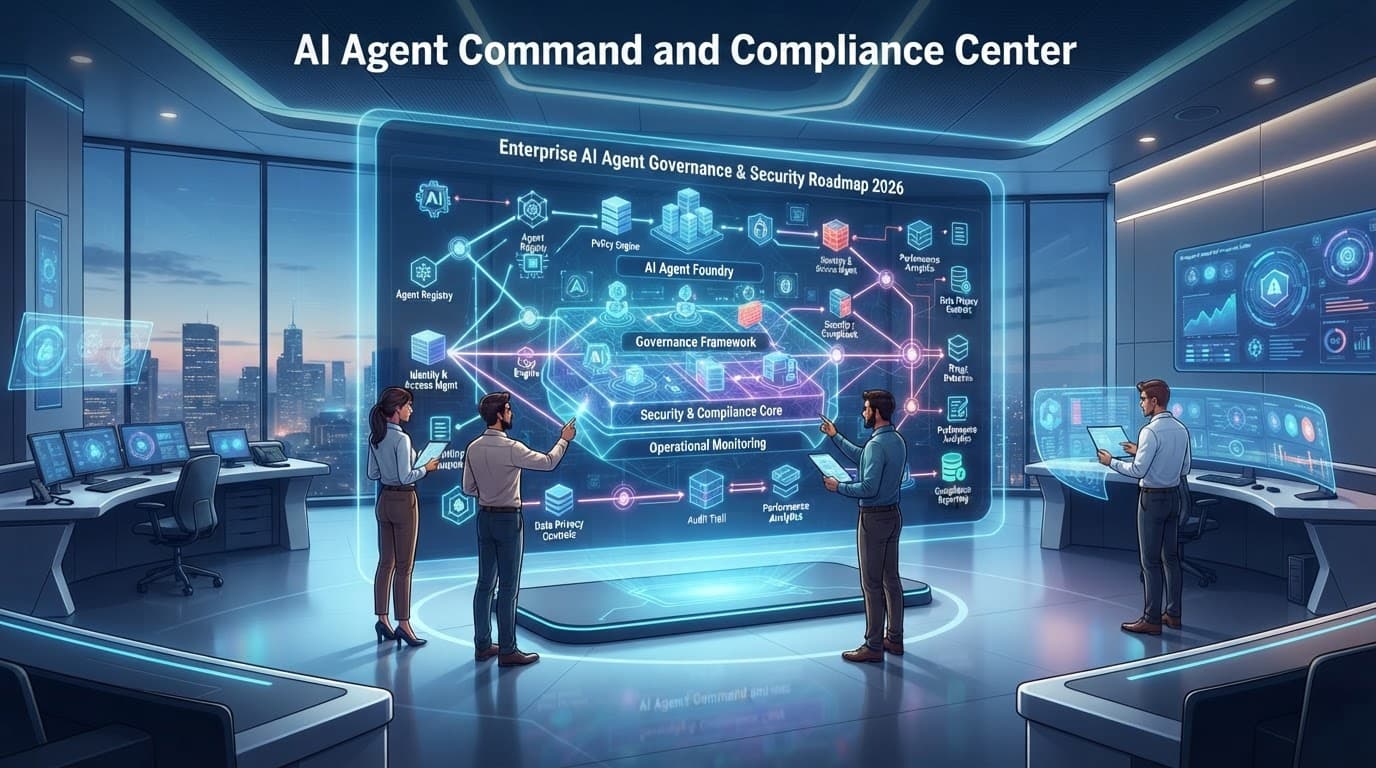
Enterprise AI agents are no longer experimental curiosities—they are business-critical infrastructure executing sensitive workflows across finance, healthcare, legal, and operations. Yet the gap between ambition and accountability is widening. Organizations are discovering that agents deployed without embedded governance create compliance debt that compounds faster than technical debt.
The difference between AI pilots that stall at compliance review and agents processing invoices autonomously in production is not ambition. It is architecture. This roadmap distills current best practices from platform architects, governance specialists, and enterprise implementers into actionable guidance for building AI agents that are secure, compliant, and scalable from the ground up.
The urgency is measurable. According to AvePoint's State of AI 2026 Report, 88.4% of organizations experienced at least one security breach tied to an AI agent in the past 12 months, and 95.5% took at least one mitigating action, most commonly adding human-in-the-loop controls. These figures underscore a fundamental truth: retrofitting security and compliance after deployment is exponentially more costly and less effective than embedding it from inception.
At Jetruby, the design of enterprise AI agents begins with a security-first mindset and an architecture-driven approach. AI agents are treated not as standalone tools, but as integral components of enterprise infrastructure—capable of executing business-critical tasks while fully respecting regulatory and organizational boundaries. Security and compliance are not afterthoughts; they are embedded into every layer of design and implementation.
This philosophy aligns with what Sema4.ai identifies as the critical distinction between enterprise platforms and open-source frameworks: enterprise AI platforms come with built-in security, governance, and business-user tooling out of the box, while open-source developer frameworks give technical teams more flexibility but require them to build compliance, monitoring, and orchestration controls themselves before the solution is enterprise-ready.
The first step in any enterprise AI agent methodology is comprehensive risk mapping. This process involves multiple dimensions:
Recognized standards give the framework external teeth. Benchmarking against NIST's AI Risk Management Framework and ISO/IEC 42001 gives compliance teams something to test the framework against, not just an internal document nobody outside IT has reviewed.
An enterprise AI agent governance framework applies the same four policy domains across all platforms:
| Policy Domain | Description | Key Controls |
|---|---|---|
| Identity & Authentication | How agents prove who they are and what systems they represent | Enterprise identity integration, service principals, credential vaulting |
| Permissions & Access | What data and actions agents are authorized to access | RBAC, least-privilege design, dynamic authorization |
| Audit & Monitoring | How agent behavior is logged, observed, and analyzed | Telemetry streaming, drift detection, immutable audit trails |
| Lifecycle Management | How agents are provisioned, updated, and decommissioned | Version control, change management, sunset procedures |
Coverage must span every cloud. Agents get built inside Microsoft 365 and Google Workspace alike, and a framework written for only one is not an enterprise framework.
With discovery insights in hand, organizations move to designing enterprise-grade architecture. Critical decisions include:
Data control options such as VPC deployment keep data within your security boundary. This is particularly critical for healthcare organizations, as demonstrated by a well-known healthcare organization that deployed OpenClaw through an AI Gateway, enabling secure, monitored access while maintaining HIPAA compliance and data protection standards.
BCG identifies the control plane as essential for security and compliance at scale. A control plane ensures that agents are built and operated in a governed way, providing the controls and visibility needed to:
Security and compliance has always been at the core of governance programs, but too often this has been the only goal. The control plane extends governance into operational excellence, enabling proactive rather than reactive management.
A golden path is a pre-governed, production-ready asset in which identity, registration, monitoring, and policy enforcement are already wired in, so a builder inherits full compliance from the outset. This is a well-established platform engineering practice—using standardized templates that embed enterprise standards directly into the starting point for any new build.
In practice, golden paths are standardized templates that have governance built in. Rather than asking developers to learn and implement governance controls from scratch, a golden path provides a production-ready agent scaffold that is:
The developer customizes the business logic; the governance layer is handled automatically. The mechanism is a common intake form that triggers an automated pipeline to provision a repository with the full agent template and working infrastructure. What previously took weeks of setup now takes a day.
| Component | Purpose | Compliance Benefit |
|---|---|---|
| Identity Integration | Automatic authentication against enterprise directory | Eliminates credential sprawl and shadow identities |
| Policy Enforcement Module | Pre-configured guardrails for data access and action boundaries | Ensures consistent application of governance rules |
| Audit Stream Connector | Automatic telemetry to centralized logging | Creates immutable compliance evidence |
| Drift Detection Hook | Baseline behavior profiling with anomaly alerts | Enables proactive intervention before incidents |
| Human-in-the-Loop Trigger | Escalation points for high-risk decisions | Supports regulatory requirements for meaningful oversight |
AI governance tooling cannot operate in isolation. It must feed into and draw from the security infrastructure already defending the enterprise. The recommended enterprise pattern in 2026 is hybrid: buy a governance platform for policy management, regulatory mapping, and audit trail generation, then build custom connectors for in-house model monitoring, domain-specific fairness evaluation, and integration with proprietary data pipelines.
Four integration points carry the highest return:
Sema4.ai underscores that enterprise-grade security is non-negotiable. Essential features include:
Enterprise AI platforms must demonstrate the ability to handle high-volume, complex workflows without performance degradation. Evaluate the platform's uptime guarantees, redundancy measures, and infrastructure architecture to ensure it can reliably support mission-critical business processes at enterprise scale.
The ability for business users, not just developers, to quickly build and deploy agents is crucial for rapid time-to-value and scaling automation across the organization. However, this democratization must not come at the cost of governance. The most effective platforms embed governance so seamlessly that business users operate within guardrails they never see but always benefit from.
| Pitfall | Why It Happens | How to Prevent It |
|---|---|---|
| Platform-specific silos | Teams develop mature policy for one cloud, ad hoc for others | Mandate unified framework across all agent-building platforms |
| Governance as documentation only | Frameworks become paper exercises without enforcement | Automate policy application through control planes and golden paths |
| Developer burden overload | Requiring manual compliance implementation for every agent | Shift compliance left through pre-governed templates |
| Monitoring gaps | Insufficient telemetry for agent behavior analysis | Standardize audit streams as non-negotiable architectural requirement |
| Post-incident retrofitting | Security added only after breach or near-miss | Embed security-first mindset in organizational culture and procurement |
Governance is a decision: what guardrails do the organization's risk posture necessitate, and what compliance mandates do they need to meet. A platform is how that decision gets applied and proven at scale across potentially thousands of agents. You need both; neither alone is sufficient.
Traditional CI/CD templates standardize deployment mechanics. Golden paths embed governance—identity, registration, monitoring, and policy enforcement—so that compliance is inherited rather than implemented. They represent a higher level of abstraction that includes but exceeds deployment automation.
Start with NIST AI Risk Management Framework and ISO/IEC 42001 as baseline benchmarks. Layer sector-specific requirements (HIPAA for healthcare, PCI DSS for payments) and regional regulations (EU AI Act, state privacy laws) based on your operational footprint.
Yes, but with significant investment. Open-source developer frameworks provide flexibility but require teams to build compliance, monitoring, and orchestration controls themselves before the solution is enterprise-ready. For most organizations, the recommended hybrid approach—commercial governance platform plus custom connectors—balances speed and control.
The control plane architecture is specifically designed for this challenge. Automated registration, standardized telemetry, and policy-as-code enable governance at scale without linear growth in operational overhead.
Enterprise AI agent governance in 2026 is not about choosing between innovation and control—it is about architecting systems where both are mutually reinforcing. The organizations succeeding with agentic AI are those that treat governance as infrastructure, not insurance.
This means security-first design from the first line of architecture, control planes that provide real-time visibility and intervention capability, golden paths that make compliance the path of least resistance, and continuous integration with existing security investments. It means recognizing that governance frameworks must span every cloud where agents are built, and that recognized standards provide the external credibility that internal policies alone cannot.
The roadmap is clear: map risks comprehensively, select architecture deliberately, embed governance automatically, and operate continuously. The enterprises that master this sequence will deploy AI agents at scale with confidence. Those that do not will find themselves in the 88.4%—reacting to breaches rather than preventing them, and paying the premium that retrofitting always demands.
Start with your next agent project. Apply these principles from day one. The compliance you build in today becomes the competitive advantage you operate with tomorrow.

Content Team
We are a team of AI enthusiasts and educators dedicated to helping you navigate the complex world of Artificial Intelligence. Our mission is to provide clear, actionable learning paths for every tech career.
Stop guessing what to learn next. Let our AI generate a personalized, step-by-step learning roadmap tailored exactly to your goals and current skill level.
Get Started for Free