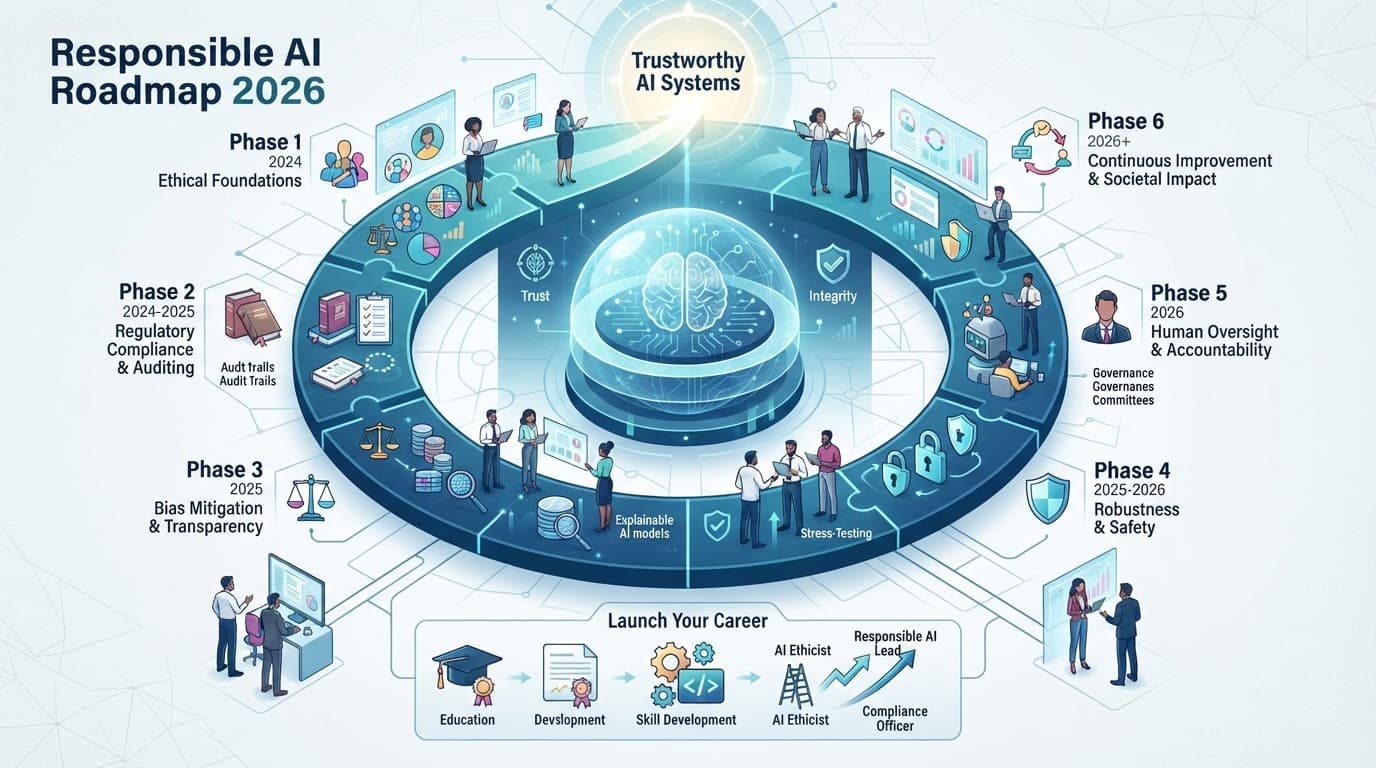
As artificial intelligence becomes deeply embedded in business processes and daily life, the question is no longer whether organizations should prioritize ethical AI, but how. In 2026, responsible AI has evolved from a compliance exercise into a strategic organizational capability—one that accelerates innovation rather than slowing it down. For professionals entering the field, this shift creates unprecedented opportunities at the intersection of technology, ethics, and governance.
This roadmap explores the essential principles, practical frameworks, and emerging career paths that define trustworthy AI in 2026.
Trustworthy AI rests on foundational ethical principles that ensure systems align with human values and societal expectations. Leading responsible AI frameworks consistently identify several critical characteristics:
These principles translate into concrete practices. Organizations now build ethical checks into every stage of development—bias testing during development, human review before deployment, and ongoing monitoring after launch. Waiting until a system is finished to consider fairness or privacy is no longer acceptable.
Traditional model risk management frameworks are struggling to keep pace with modern AI systems. As models become more dynamic and are retrained in real time with streaming data, governance must evolve into a continuous assurance function.
This evolution represents a fundamental shift: model risk management is transforming from a compliance checkpoint into a strategic differentiator. Organizations that treat governance as a dynamic, AI-enabled framework rather than a static control function build resilience, trust, and competitive advantage.
One of the most persistent misconceptions about responsible AI is that governance impedes progress. In reality, the opposite is true. Responsible AI deployment gives organizations the confidence to move faster by establishing the safety mechanisms, ethical controls, and operational oversight needed to ensure AI remains trustworthy as it scales.
When responsible AI activities become part of the operating model—rather than bolted-on compliance exercises—they enable:
Almost half of surveyed IT leaders plan to increase AI-related budgets by 20% or more in 2026, with top investment areas including governance automation, AI risk tooling, and talent development. The market is moving toward governance as an enabler, not an obstacle.
Building trustworthy AI requires structured processes at every phase. Based on leading frameworks, the lifecycle includes:
| Phase | Key Activities | Ethical Considerations |
|---|---|---|
| Assess | Conduct AI inventory; identify governance gaps | Map potential impacts on stakeholders and communities |
| Prioritize | Focus governance on high-risk systems | Apply proportionate oversight based on harm potential |
| Build | Assemble cross-functional teams (data science, legal, compliance, business) | Embed diverse perspectives in design decisions |
| Deploy | Launch with guardrails, approvals, documentation, and oversight | Ensure explainability and human review mechanisms |
| Monitor | Continuously review performance, manage incidents, evaluate risks | Maintain accountability as systems evolve |
Organizations that implement structured AI governance build trust, minimize liabilities, and improve long-term AI adoption strategies. This isn't optional anymore—it's the foundation of responsible AI.
The growing emphasis on ethical AI has created demand for professionals who combine technical AI knowledge with expertise in ethics, policy, and social science. These emerging roles represent exciting career paths for those interested in technology's societal impact.
These roles require hybrid skill sets. An AI Ethics Specialist, for example, must understand both the technical architecture of AI systems and the philosophical frameworks for evaluating their impacts. Similarly, AI systems engineers need visibility into how systems work, how to scale them, and the challenges that emerge at scale.
The AI career path isn't linear. Professionals enter from diverse backgrounds:
Regardless of entry point, foundational skills remain essential: databases, at least one programming language, and understanding of how AI systems integrate into broader technical infrastructure.
2026 marks a pivotal moment for AI regulation. The EU AI Act has established precedent for risk-based regulatory frameworks, and organizations worldwide are adapting their operating models accordingly. Key focus areas include:
Organizations that proactively build regulatory compliance into their development processes avoid the scramble of reactive adaptation. More importantly, they demonstrate trustworthiness to customers, partners, and regulators—creating market differentiation.
AI ethics addresses broader questions of how AI should be used and what values it should reflect. Responsible AI encompasses the practical implementation of ethical principles through governance frameworks, technical controls, and organizational processes. Ethics provides the "why"; responsible AI provides the "how."
Yes. Organizations with mature governance capabilities can deploy AI more confidently and rapidly because they've established clear guardrails, approval processes, and risk management mechanisms. Governance reduces uncertainty and enables faster, more sustainable scaling.
Successful AI ethics professionals typically combine technical literacy (understanding how AI systems work) with expertise in philosophy, law, social science, or policy. The field values diverse perspectives, and many enter from non-technical backgrounds with intentional skill-building in AI fundamentals.
Start with high-risk systems, implement basic bias testing and documentation, and leverage available governance platforms. The principles apply regardless of organization size—proportionality is key. Even simple checklists and review processes significantly improve outcomes.
Explainability is essential for building trust with stakeholders and ensuring regulatory compliance. It enables users and regulators to understand how black-box models produce outputs, supports debugging and improvement, and helps identify potential bias or errors.
Building trustworthy, safe, and governed AI systems in 2026 isn't about achieving perfection—it's about making consistent progress. Organizations that embed ethical principles into their development lifecycles, evolve governance into continuous assurance, and invest in emerging talent will be best positioned to harness AI's benefits while maintaining societal trust.
For individuals, the responsible AI field offers meaningful work at the frontier of technology and human values. Whether you're transitioning from software engineering, data science, policy, or social sciences, pathways exist to contribute to AI systems that respect human dignity, promote fairness, and serve broad societal interests.
The market is moving. Investment in governance automation, risk tooling, and talent development is accelerating. The question for both organizations and professionals is whether you're moving with it—and whether you're prepared to build AI that earns and deserves public trust.
Ready to start your responsible AI journey? Explore structured learning paths and hands-on projects at LearnAIRoadmap.com.

Content Team
We are a team of AI enthusiasts and educators dedicated to helping you navigate the complex world of Artificial Intelligence. Our mission is to provide clear, actionable learning paths for every tech career.
Stop guessing what to learn next. Let our AI generate a personalized, step-by-step learning roadmap tailored exactly to your goals and current skill level.
Get Started for Free