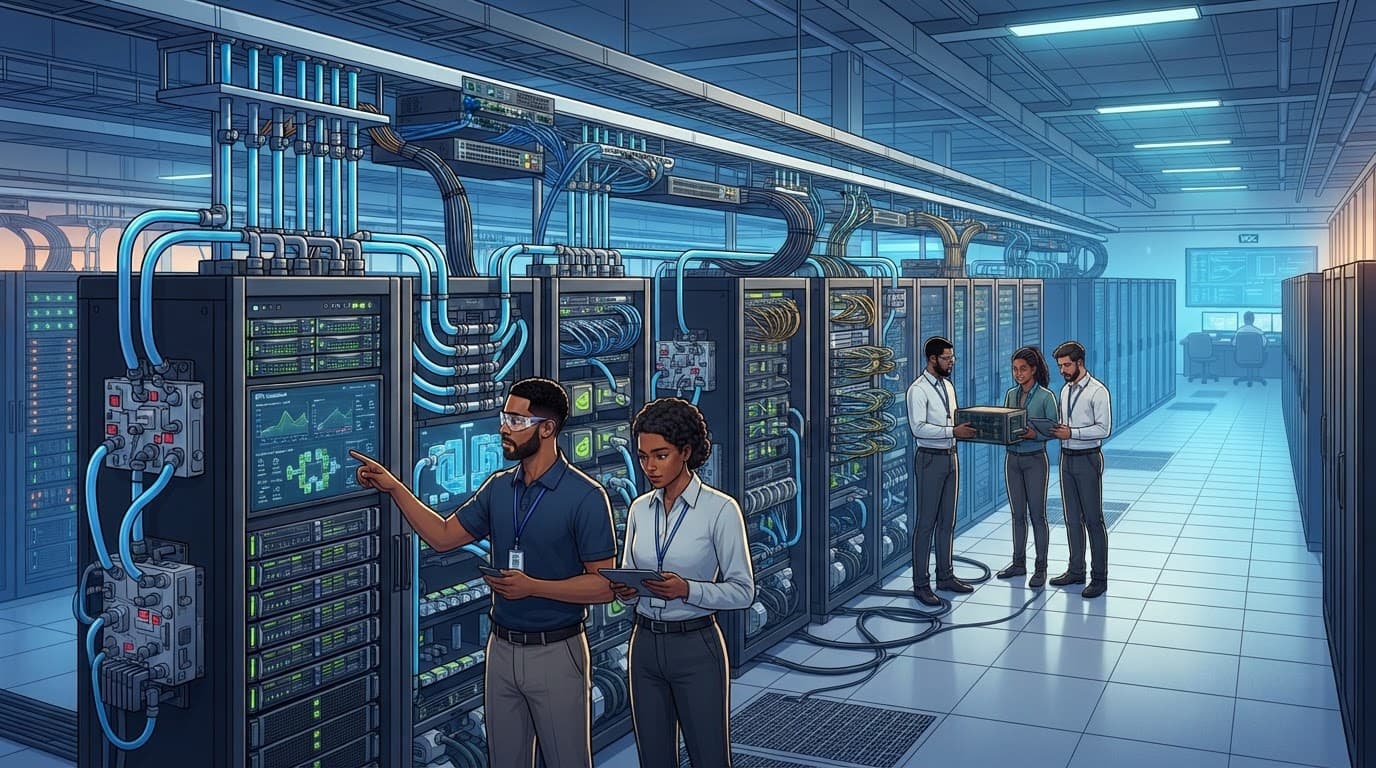
The headlines in 2025 were all about AI models getting smarter. In 2026, the story has shifted to what keeps those models running: power, cooling, and physical infrastructure. Hyperscalers are pouring billions into custom silicon, liquid-cooled mega-clusters, and dedicated power infrastructure—effectively building digital power plants where energy and data are the fuel, and AI services are the output.
This infrastructure explosion has created a talent gap that few saw coming. While much career advice jumps straight to machine learning and prompt engineering, one of the most underrated opportunities in 2026 is building and operating the infrastructure that AI actually runs on. For professionals in networking, data center operations, power engineering, and related fields, this represents a rare career inflection point—the chance to move closer to high-value AI work without abandoning core infrastructure expertise.
The scale of AI infrastructure investment is staggering. AI data centers are on track for trillions of dollars in compute capital expenditure by 2030. These facilities can draw hundreds of megawatts—enough to power a small city—and could consume 12% of U.S. electricity by 2028. Large AI training jobs with spiking compute demands already have visible impacts on grid stability.
This creates a multidimensional crunch:
The professionals who solve these problems are becoming some of the most valuable—and hardest to replace—people in technology.
AI is not replacing traditional infrastructure roles; it is expanding them into entirely new career pathways across cloud, data centers, and high-performance computing. Here are the most promising entry points for career pivoters.
This is a natural fit for professionals who already understand routing, switching, VLANs, overlays, segmentation, and fabric design. The critical difference in 2026: AI workloads create unprecedented pressure around east-west traffic, throughput, telemetry, and reliability. A traditional network engineer who learns AI infrastructure language becomes far more valuable in data center modernization projects.
Key focus areas include GPU cluster networking, high-throughput fabrics, and the shift to 800 VDC power distribution with advanced liquid cooling systems.
This role sits close to observability and incident response, but with AI-specific complexity. It is not only about keeping devices online—it is about monitoring AI infrastructure health, understanding dependency chains, catching performance issues early, and helping teams restore service quickly when a workload behaves unexpectedly.
Here is where cost optimization becomes a career superpower. Professionals who master GPU arbitrage, cloud infrastructure build optimization, and efficient call routing to GPUs are optimizing for collectively the largest infrastructure build in human history. At trillion-dollar scale, even fractional efficiency improvements justify premium salaries.
Perhaps the most acute shortage. States are offering incentives for battery storage and microgrid development, but there is a fundamental bottleneck: not enough qualified, experienced power engineers and skilled tradespeople to bring these projects to fruition. Traditional power engineering roles are in a period of intense evolution toward AI-specific demands.
Not every AI workload lives in hyperscale facilities. Edge AI gives forgotten sites a second life, as enterprises deploy inference and smaller-scale training locally for vertical-specific use cases. This creates demand for professionals who can design and operate distributed, lower-density AI infrastructure.
Several infrastructure shifts are reshaping what "qualified" means:
| Legacy Approach | 2026 AI-Ready Standard |
|---|---|
| Air cooling | Direct-to-chip and cold-plate liquid cooling |
| Traditional power distribution | 800 VDC distribution (lower losses, less copper) |
| General-purpose data center design | AI-readiness as standard design requirement |
| Proprietary hardware stacks | Open Compute Project (OCP) as default playbook |
| Centralized hyperscale-only | Edge AI pods in general-purpose facilities |
Architectures like NVIDIA's Kyber racks—with vertical compute blades, 800 VDC distribution, and integrated liquid cooling—point where high-density AI infrastructure is heading. Operators designing around legacy assumptions risk locking themselves out of future deployments.
This roadmap is designed for working professionals who cannot pause their careers. It builds systematically from existing infrastructure knowledge toward AI-specific expertise.
Months 1–2: Networking Fundamentals
Months 3–4: Systems and Automation Basics
The best candidates often underestimate how transferable their skills are:
| Your Background | Natural AI Infrastructure Path |
|---|---|
| Network engineer (routing, switching, fabrics) | Data Center Network Engineer → AI Cluster Networking |
| Systems / DevOps engineer | AI Operations Engineer / MLOps Infrastructure |
| Electrical / power engineer | AI Data Center Power Engineering (critical shortage) |
| Mechanical / thermal engineer | Liquid Cooling / Thermal Design for GPU Clusters |
| Cloud infrastructure engineer | Cloud AI Infrastructure / GPU Arbitrage Specialist |
| Data center operations / facilities | AI-Ready Facilities Management / Edge AI Deployment |
Mechanical, civil, chemical, and electrical engineers are far better positioned than they realize. The systems thinking, constraint optimization, and physical reality mental models from traditional engineering transfer directly to AI infrastructure challenges.
The labor market data is unusually favorable for pivoters:
Here is the disconnect that defines 2026: every company is deploying AI. The engineering conversation overwhelmingly focuses on building AI features and writing AI agents. But someone must run the systems those models actually run on—the GPU clusters processing training runs, the serving infrastructure handling inference at scale, the ML platforms that let data scientists ship models without filing tickets with the core infrastructure team. That someone is increasingly rare, increasingly well-compensated, and increasingly frustrated with the flattened "AI engineer" label.
No. Infrastructure roles require understanding how ML workloads behave—training versus inference patterns, GPU memory demands, data pipeline throughput—but not building models. Your systems expertise is the scarce asset.
For network engineers specifically targeting data center AI roles, the DCAI provides structured validation of AI infrastructure concepts. The DCAIE and DCAIAOT training paths offer credible preparation. However, hands-on portfolio work often carries equal or greater weight with hiring managers.
Hyperscale focuses on massive training clusters with liquid cooling and dedicated power. Edge AI distributes inference and smaller workloads across many locations, emphasizing efficiency, reliability without constant human presence, and integration with existing facilities. Both need skilled infrastructure engineers.
GPU arbitrage means optimizing which workloads run on which GPU resources—cloud versus on-prem, spot versus reserved instances, training versus inference-optimized hardware. At scale, these decisions determine millions in annual spend. Specialists who master this are among the most valued infrastructure hires.
The evidence suggests the opposite. AI is expanding infrastructure roles rather than replacing them. The complexity of AI workloads—unpredictable power draws, specialized cooling, high-throughput networking—creates demand for human expertise in planning, troubleshooting, and optimization that automation cannot yet handle.
Success in this pivot requires more than technical learning. Consider these strategic moves:
Document cost impact: If you have optimized infrastructure in any previous role, quantify the savings. GPU arbitrage and cloud cost optimization are hiring priorities; proven results differentiate you.
Speak the language: Learn to describe traditional infrastructure experience in AI-relevant terms. East-west traffic optimization becomes "GPU cluster fabric design." Power distribution engineering becomes "800 VDC AI rack power architecture."
Target the right employers: Hyperscalers need specialists at massive scale. AI-native companies need generalists who can build from scratch. Enterprise data centers need pragmatists who can add AI capacity to existing facilities. Each values different experience profiles.
Consider geographic flexibility: The AI infrastructure build is concentrated in specific regions with available power and favorable policy. Willingness to relocate to these emerging hubs can accelerate career progression.
The AI power crunch is not a temporary disruption—it is a structural transformation in how digital infrastructure is designed, built, and operated. For professionals with relevant technical foundations, this represents one of the most favorable career pivot environments in decades: urgent demand, insufficient supply, and barriers to entry that favor experience over credentials alone.
The professionals who thrive will combine deep infrastructure expertise with AI-specific fluency. They will understand not just how to keep systems running, but how to optimize the largest infrastructure build in human history for cost, efficiency, and reliability. They will be the people who make AI scale—not in theory, but in physical reality.
The roadmap is clear. The timeline is achievable. The market need is verified. The question is not whether the opportunity exists, but whether you will position yourself to capture it.

Content Team
We are a team of AI enthusiasts and educators dedicated to helping you navigate the complex world of Artificial Intelligence. Our mission is to provide clear, actionable learning paths for every tech career.
Stop guessing what to learn next. Let our AI generate a personalized, step-by-step learning roadmap tailored exactly to your goals and current skill level.
Get Started for Free