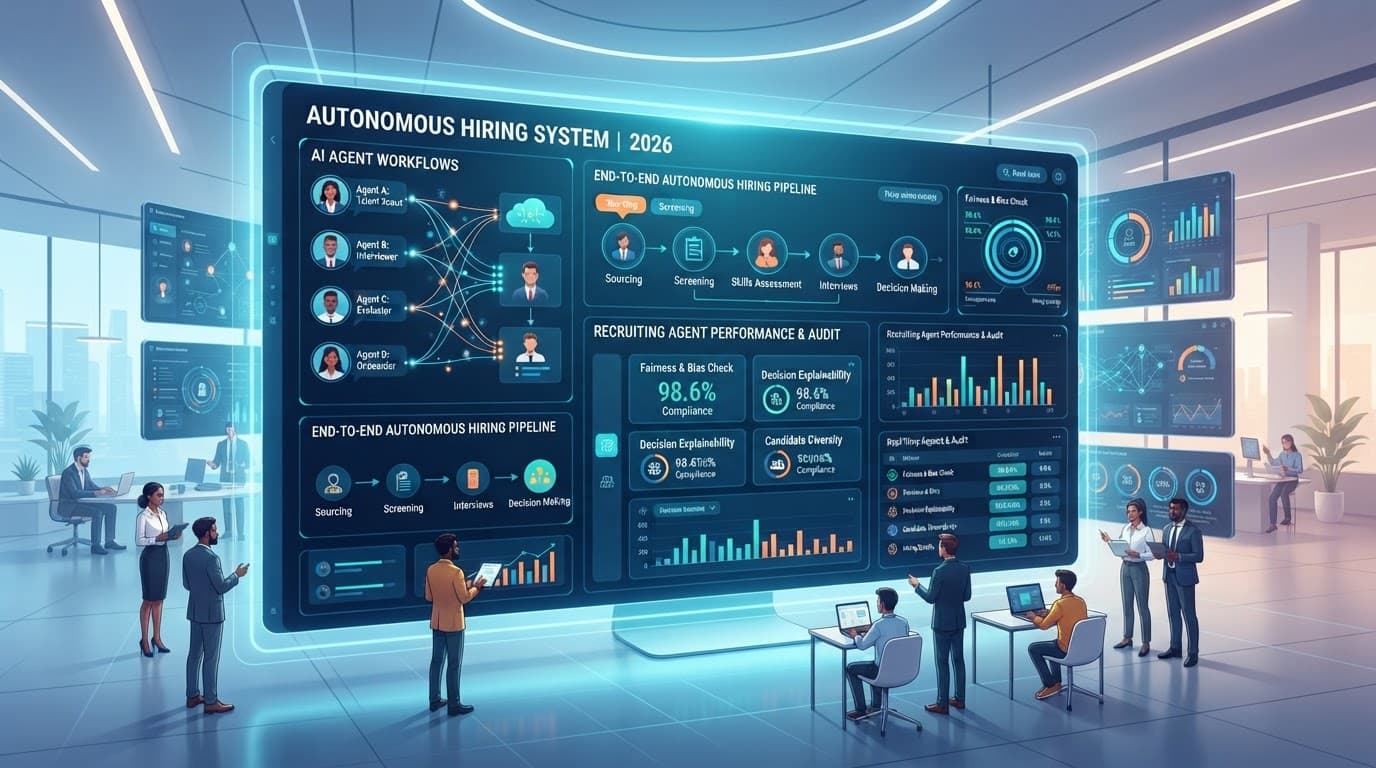
AI recruiting agents are no longer experimental technology. In 2026, they have become the operating layer of modern talent acquisition, autonomously executing multi-step hiring workflows that once consumed the majority of recruiters' time. With 52% of talent leaders planning to deploy autonomous AI agents this year, according to Korn Ferry's 2026 Talent Acquisition Trends report, understanding how to build and audit these systems is now a core competency for HR and talent acquisition leaders.
This guide breaks down what AI recruiting agents actually do, how to implement them responsibly, and the audit practices that keep your organization compliant with rapidly evolving regulations.
An AI recruiting agent is autonomous software that sources, screens, contacts, and schedules candidates without requiring a human to manage each individual step. Unlike traditional AI-assisted tools that handle single tasks—such as parsing resumes or sending automated emails—recruiting agents connect the entire top-of-funnel workflow into one continuous, adaptive process.
The distinction matters. As industry analysis notes: "Real agents act independently, chatbots do not. If it needs a human click for each task, it is a workflow, not an agent." A chatbot answers questions within scripted flows; an AI agent plans and executes multi-step tasks, adapting its next action based on new information rather than responding to one prompt at a time.
Current adoption data illustrates this shift. While SHRM's 2026 research puts AI in talent acquisition at 27% of organizations, most of that usage remains limited to individual tasks. The gap between assisted tools and true agents represents both the challenge and opportunity for talent teams in 2026.
Recruiting has emerged as one of the first practical proving grounds for agentic AI because the work is inherently repetitive, data-intensive, and time-sensitive. Consider the typical recruiter's week: 40-50% of time spent on sourcing, 15-20% on scheduling coordination, with relationship building and strategic decision-making squeezed into the margins.
Gartner projects that 40% of enterprise applications will feature task-specific AI agents by the end of 2026, up from less than 5% a year earlier, with resume screening, scheduling, and candidate evaluation named as proven early use cases. The architecture is evolving from a single assistant helping a recruiter toward specialized agent teams—one sourcing, one screening, one coordinating—that a recruiter supervises like a manager overseeing a pod.
This shift creates a critical career inflection point. As one industry analysis puts it: "If most of your hours still go to tasks an agent could do, you are operating as an executor in a market that increasingly pays for orchestration."
Gartner estimates that out of thousands of vendors claiming agentic AI capabilities, only about 130 offer legitimate solutions. Here are the criteria that separate true autonomous hiring agents from repackaged automation tools:
| Criterion | What to Evaluate | Why It Matters |
|---|---|---|
| Database size and quality | Number of profiles indexed, refresh frequency, geographic coverage | Data quality directly limits what the agent can find and recommend |
| Outreach channels | Email, voice, SMS, social platforms supported | Multi-channel engagement improves candidate response rates |
| ATS integration | Native integration vs. API limitations, data sync direction | Agentic recruiting loses half its value if candidate data lives in a separate system |
| Guardrails and auditability | Bias audit capabilities, human review checkpoints, decision logging | Required for EU AI Act compliance and defensible hiring practices |
| Pricing transparency | Per-seat, per-hire, or usage-based models; hidden integration costs | Predictable budgeting for scale decisions |
When evaluating database claims, dig deeper than headline numbers. Ask how often data is refreshed and whether coverage includes the regions where you hire. Some tools only access publicly available LinkedIn data, which limits reach to a single platform regardless of total profile count.
Audit your current workflow. Map every step from job requisition to offer acceptance. Identify where your recruiters spend the most hours—these become your automation targets.
Set baseline metrics. Document current time-to-fill, cost-per-hire, outreach response rate, and source-of-hire breakdown. These become your "before" numbers for ROI measurement.
Choose your platform and integrate with your ATS. If integration wasn't established during vendor evaluation, prioritize it now. You need sourced candidates flowing directly into your pipeline without manual transfer.
Pilot on one requisition type. A contained pilot with clear before/after metrics—time-to-shortlist, recruiter hours saved, candidate response rate—gives you real evidence before wider rollout.
Design human checkpoints explicitly. Decide where a person reviews or overrides an agent's output, especially at the screening stage where audit and fairness stakes are highest.
Build the audit trail from the start. Every agent decision—shortlist, rejection, scheduling choice—must be logged with the reasoning behind it. This is not optional under most current or upcoming hiring AI regulation.
Run impact ratio checks. Compare selection rates across gender, ethnicity, and age at each funnel stage. Any group whose selection rate falls below 80% of the highest-performing group should trigger immediate review.
Roll out across all open positions. At this point, your team should treat the agent as a team member, not a tool. It handles the top of funnel; your recruiters handle relationship building, interviews, and closing.
Build feedback loops. Agents improve only when fed outcome data. Mark which candidates were hired, which reached final rounds, and which were rejected early. This feedback trains the system to refine its recommendations.
The regulatory environment for AI hiring tools has shifted from guidance to enforcement. Understanding these requirements is essential for any 2026 deployment.
As of 2025, AI systems used in employment and recruitment are classified as "high-risk" under the EU AI Act. Organizations operating in the EU or processing data of EU-based candidates must meet requirements around:
The U.S. landscape is fragmented but expanding:
Organizations getting compliance right share common practices:
The gap between hiring-manager trust and candidate trust in AI-driven hiring remains wide. Governance is now a design requirement, not an afterthought.
Trust gaps tend to open when AI decisions are opaque. Building an audit trail and disclosure into the process from the start avoids most of that friction. Best practices include:
When implemented properly, AI can actually reduce certain biases by scoring every candidate against the same criteria, at the same standard, regardless of when they apply. The key is building those guardrails intentionally rather than assuming neutrality.
A chatbot answers questions within a scripted or retrieval-based flow. An AI agent plans and executes multi-step tasks—like sourcing, ranking, and contacting candidates—adapting its next action based on new information rather than responding to one prompt at a time.
Yes. The EU AI Act classifies hiring AI as high-risk, requiring transparency, human oversight, and audit trails. In the U.S., New York City mandates bias audits, California provides data privacy rights, and multiple states are developing additional frameworks.
Measure against your baseline metrics: time-to-fill, cost-per-hire, outreach response rate, and recruiter hours saved. Also track quality indicators like hiring manager satisfaction and candidate experience scores to ensure speed doesn't come at the expense of fit.
Off-the-shelf agents solve narrow tasks fast with lower implementation risk. Custom-built agents solve for how your specific organization actually hires but require significantly more data science resources and ongoing maintenance. Most organizations should pilot with established platforms before considering custom builds.
AI recruiting agents represent more than a technology upgrade—they signal a fundamental restructuring of how talent acquisition operates. The organizations that thrive in 2026 and beyond will be those that deploy agents to handle execution while reinvesting human expertise into the relationships and judgments that no algorithm can replicate.
The path forward is clear: start with a contained pilot, build audit trails from day one, establish human checkpoints at high-stakes decisions, and scale only with verified evidence of both efficiency gains and fair outcomes. The future of recruiting is not just automated. It is autonomous, auditable, and intentionally human where it matters most.

Content Team
We are a team of AI enthusiasts and educators dedicated to helping you navigate the complex world of Artificial Intelligence. Our mission is to provide clear, actionable learning paths for every tech career.
Stop guessing what to learn next. Let our AI generate a personalized, step-by-step learning roadmap tailored exactly to your goals and current skill level.
Get Started for Free