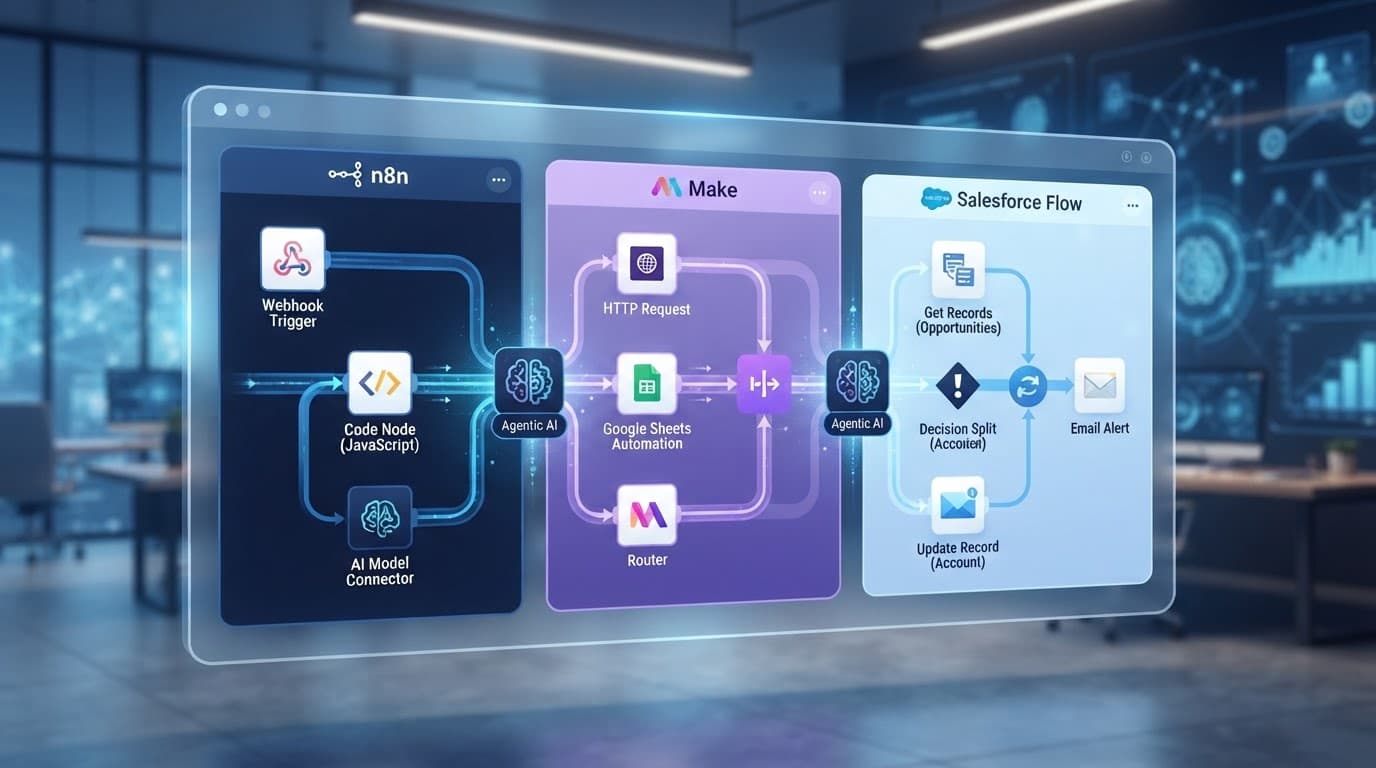
The automation market is maturing fast. The days of choosing between "basic app connections" and "six-figure enterprise implementations" are over. In 2026, a powerful middle tier has emerged where professionals can build sophisticated, AI-powered workflows without massive budgets or large engineering teams.
For career-minded professionals, this shift creates a clear opportunity. Companies urgently need specialists who can orchestrate intelligent systems across platforms—professionals who understand not just how to connect apps, but how to embed decision-making intelligence into automated workflows. This roadmap focuses on the three platforms defining that opportunity: n8n, Make, and Salesforce Flow.
Traditional automation connected applications. Agentic automation embeds intelligence—systems that analyze, decide, and act with minimal human intervention. This distinction matters enormously in the job market.
Organizations now seek professionals who can build workflows where AI agents:
These capabilities sit at the intersection of technical implementation and strategic business value—precisely where compensation peaks.
n8n occupies a unique position. Unlike platforms that emphasize simplicity alone, it provides visual editing for fast iteration while supporting complex business logic, branching conditions, and agentic AI orchestration under the hood.
Key capabilities that differentiate n8n for high-value work:
| Capability | Business Application |
|---|---|
| Self-hosting | Data sovereignty, compliance, and cost control at scale |
| Custom JavaScript/Python | Complex transformations beyond visual builder limits |
| Modular subflows | Reusable components across enterprise workflows |
| Native API integration | Direct connection to internal systems and custom tools |
| AI agent orchestration | Multi-step decision-making with LLM integration |
n8n's development roadmap emphasizes three intelligence layers:
Predictive Workflows: AI analyzes historical patterns to forecast outcomes and trigger automation proactively rather than reactively.
Intelligent Routing: Tasks automatically assign based on workload distribution, expertise matching, and priority scoring.
Anomaly Detection: Continuous monitoring of data streams identifies irregularities before they become operational issues.
For technical teams, n8n's source-available model and self-hosting option (free tier available; Cloud from $20/month) provide ownership that SaaS-only platforms cannot match. When AI logic evolves quickly—and it does—this flexibility becomes critical.
Make (formerly Integromat) excels where visual control over data manipulation matters. Its scenario builder provides detailed control over how information flows between applications, with particular strength in transforming and enriching data mid-workflow.
A representative use case: summarizing Gmail emails with OpenAI, then routing results to Slack with formatted context. This pattern—ingest, intelligently process, distribute—appears constantly in marketing operations, sales support, and internal reporting workflows.
Make's "Grid" for AI orchestration provides a high-level view of an organization's agents, applications, and workflows. This observability layer aids performance improvement and simplifies debugging across complex multi-step automations—capabilities that enterprise clients specifically request.
Pricing starts with a functional free tier; Core plans begin at $9/month, making skill acquisition accessible before career transition.
Based on platform comparison analysis, Make fits best when:
Many professionals find Make the fastest path to building portfolio pieces that demonstrate tangible business value.
Salesforce Flow has long been the most powerful native automation engine in any CRM. The Spring 2026 release significantly expanded that lead with ten major improvements, including:
| Flow Type | Purpose | Career Relevance |
|---|---|---|
| Record-Triggered Flows | Automate when records change | Highest—replaces legacy workflow rules |
| Scheduled Flows | Batch processing at defined intervals | Essential for data maintenance and reporting |
| Approval Flows | Structured multi-stakeholder decisions | Differentiator for enterprise roles |
| Screen Flows | Guided user experiences | Growing demand with Agentforce integration |
Salesforce reports that 68% of sales representatives cite note-taking and data entry as their biggest time sinks. Flow automation that eliminates this friction delivers measurable ROI that justifies premium compensation.
Week 1: Audit and Map
Week 2: Platform Selection
Week 3-4: Core Competency
Select primary platform based on career target:
Build portfolio projects demonstrating agentic capabilities—workflows that analyze, decide, and act rather than simply connect.
Your optimal focus depends on where intelligence lives in target systems:
| AI Role | Primary Platform | Rationale |
|---|---|---|
| Peripheral automation | Make | Sufficient for structured workflows without central AI |
| Sales-facing CRM | Salesforce Flow | Native depth, Agentforce integration, enterprise demand |
| Central workflow intelligence | n8n | Maximum flexibility for evolving AI logic |
| Product-embedded experience | n8n + custom | Backend orchestration with full technical ownership |
n8n rewards JavaScript/Python knowledge for complex logic, though visual building handles many use cases. Make emphasizes visual construction. Salesforce Flow requires declarative logic understanding but not traditional coding. All three benefit from API and data structure literacy.
Salesforce Flow specialists command premium rates in enterprise consulting. n8n skills align with high-growth AI engineering roles. Make expertise fits well in marketing operations and RevOps positions. Cross-platform fluency maximizes opportunity.
With dedicated study, portfolio projects demonstrating measurable business outcomes can be built within 8-12 weeks. Many professionals begin with freelance automation projects while deepening specialization.
For compliance-sensitive industries, data sovereignty requirements, or cost optimization at scale, self-hosting provides decisive advantages. Cloud deployment offers faster initial learning. Many professionals start cloud, then migrate as requirements mature.
The best automation professionals in 2026 will not be defined by how many tools they use. They will be defined by how well their tools communicate—and how little manual work stands between business signals and intelligent responses.
Start with your biggest bottleneck. Automate it with one platform. Measure the result. Expand deliberately.
Whether you choose n8n's technical depth, Make's visual precision, or Salesforce Flow's enterprise integration, the underlying skill remains identical: designing systems where artificial intelligence makes decisions and takes action within reliable, observable, maintainable workflows.
That skill—intelligent orchestration—separates commodity automation implementers from high-value agentic AI architects. The roadmap above provides the path. The market provides the demand. Your next step is execution.

Content Team
We are a team of AI enthusiasts and educators dedicated to helping you navigate the complex world of Artificial Intelligence. Our mission is to provide clear, actionable learning paths for every tech career.
Stop guessing what to learn next. Let our AI generate a personalized, step-by-step learning roadmap tailored exactly to your goals and current skill level.
Get Started for Free