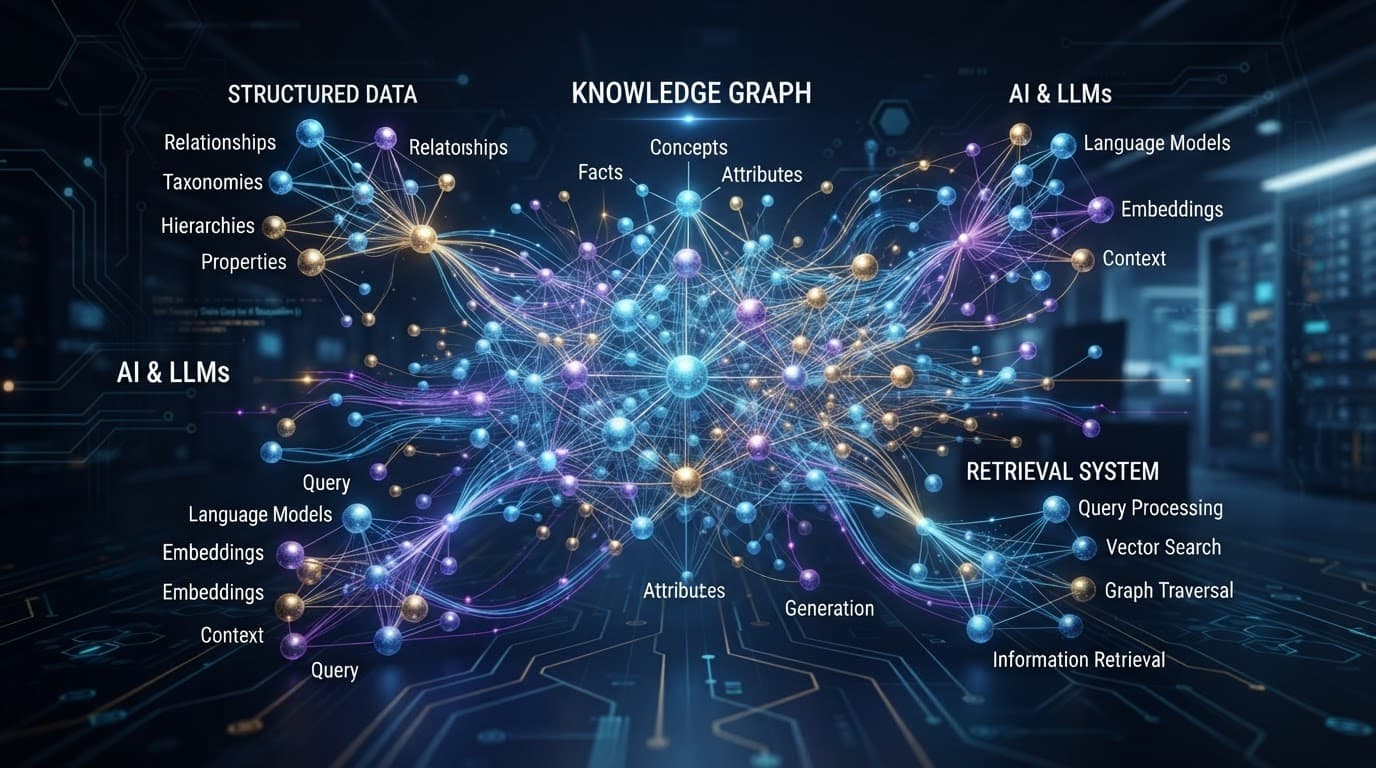
Your AI could be smarter. The knowledge is sitting in your documents, PDFs, and wikis—trapped in text your model can't reason over. That's the problem GraphRAG solves.
GraphRAG, or Graph Retrieval-Augmented Generation, represents one of the most significant developments in knowledge-augmented LLM systems over the past two years. By combining knowledge graphs with large language models, it allows AI to reason across linked data, trace relationships, and produce richer, more accurate responses than traditional retrieval methods.
Whether you're building advanced chatbots, analyzing legal documents, or exploring healthcare research, GraphRAG offers explainable and scalable results. This guide breaks down how GraphRAG works, how to build your first system, and how to position yourself for a career in this emerging field in 2026.
GraphRAG stands for Graph Retrieval-Augmented Generation. It follows the basic principles of standard RAG systems but adds a critical layer: structured knowledge graphs that preserve relationships between entities.
Unlike standard RAG that "flattens" data into chunks—leading to lost relationships and hallucinations—GraphRAG treats the knowledge graph as a trusted semantic backbone. This ensures AI responses are grounded in verifiable facts and complex relationships rather than just semantic similarity.
| Feature | Standard RAG | GraphRAG |
|---|---|---|
| Data structure | Flat text chunks | Entities, relationships, and edges |
| Retrieval method | Vector similarity search | Graph traversal + semantic search |
| Relationship awareness | Limited or lost | Explicitly preserved |
| Multi-hop reasoning | Poor performance | Strong performance |
| Explainability | Low | High—answers traceable to sources |
| Best for | FAQ systems, documentation search | Legal analysis, healthcare research, supply chain risk |
Standard RAG fails for relational reasoning tasks due to chunk fragmentation, semantic collapse, temporal blindness, and identifier failure. It remains the best tool for semantic similarity queries. But when relationships matter, GraphRAG is the superior approach.
GraphRAG operates in two distinct phases: an offline indexing phase that builds the knowledge graph, and an online query phase that uses it to answer questions.
During indexing, the system processes a corpus of unstructured text through these steps:
Microsoft Research introduced this technique in early 2024 and open-sourced it in July 2024. It has since become the reference architecture for combining LLMs with knowledge graphs. More recent innovations like LazyGraphRAG reduce indexing costs by 10–90%, making production deployment practical for more organizations.
When a user submits a query, the system:
The knowledge graph structure preserves semantic relationships between concepts, enabling more contextually relevant retrieval than traditional flat vector stores.
Building a GraphRAG system is more accessible than most assume. Here's a practical path forward.
Start with one domain and one use case. Define a small set of entities and relationships. Build a minimum viable knowledge graph. A good first project might involve product support, policy compliance, asset maintenance, supplier risk, or customer service.
The first graph should be small enough to validate and useful enough to matter. As one expert advises: build a graph over a domain you know well, so you can judge whether the model is right rather than only whether it loads.
Collect your source material—documents, datasets, or domain-specific content. From this, extract entities (such as people, concepts, or places) and the relationships between them. You can use natural language processing tools like spaCy or have LLMs perform the extraction automatically.
Here's a simplified Python example using spaCy:
import spacy
nlp = spacy.load("en_core_web_sm")

text = "Acme Ltd acquired Nova Bank in 2021. Nova Bank operates in New York."
doc = nlp(text)

# Extract entities
entities = [{"id": ent.text, "type": ent.label_} for ent in doc.ents]

# Define relations
relations = [
    ("Acme Ltd", "ACQUIRED", "Nova Bank"),
    ("Nova Bank", "OPERATES_IN", "New York")
]
These entities and connections are then stored in a graph database or graph data structure.
Key components of a GraphRAG stack include:
Hybrid architectures that combine vector search, graph traversal, and SQL lookup behind a query router are the dominant production pattern in 2025–2026.
Combine semantic retrieval with graph traversal. Add vector-searchable content to your entities. Then evaluate whether graph context improves answers compared to vector-only retrieval on multi-hop questions.
Measure retrieval gaps and expand the knowledge graph based on results. Then expose it as reusable knowledge services.
The demand for GraphRAG expertise is growing across finance, pharma, and supply chain sectors. Here's how to build the right skill set.
Data engineering, computer science, and library or information science backgrounds all appear in the field. Information science training is particularly underrated because ontology design is a classification problem before it is an engineering one.
Candidates arriving from data engineering usually need to build semantic modeling depth. Candidates arriving from library or information science usually need to build engineering skills around pipelines and scale. Both routes are well represented.
Typical advancement moves from implementation roles toward architecture and strategy:
GraphRAG is powerful but not universal. Choose wisely:
| Use GraphRAG | Stick with Standard RAG |
|---|---|
| Multi-hop reasoning required | Basic FAQ or documentation search |
| Entity relationships determine answers | Each document stands alone |
| Explainability and compliance critical | Rapid deployment with tight budget |
| Complex enterprise data with many connections | Limited data volume |
| Legal, healthcare, financial analysis | Simple semantic similarity sufficient |
The guiding principle: start simple, scale to graphs when relationships matter.
GraphRAG is a retrieval-augmented generation approach that uses structured knowledge graphs for information retrieval. Unlike standard RAG which relies on vector similarity search, GraphRAG leverages semantic relationships between entities, enabling AI to find contextually relevant information through ontologies rather than just keyword matching.
GraphRAG reduces AI hallucinations by grounding responses in structured, verified data from knowledge graphs. Because it retrieves information based on semantic relationships and organizational ontologies, AI assistants can trace answers back to specific approved sources, dramatically improving trust and relevance.
Yes. LLMs can now build knowledge graphs automatically from unstructured text, removing the primary historical barrier to knowledge graph adoption. This was demonstrated by Microsoft Research's GraphRAG implementation and has been adopted across multiple platforms.
Start by auditing your current data landscape to identify silos and assess data quality. Then prioritize building a unified semantic layer—this often means creating or adopting an enterprise ontology and beginning to structure your most critical data as a knowledge graph that AI agents can query.
Yes. Low-code solutions like Graphwise GraphRAG, announced in February 2026, are designed to turn Python prototypes into production-grade systems instantly. AWS has also demonstrated building GraphRAG-powered agents in an afternoon using existing AI tools.
Enterprise AI is moving from isolated demos toward reusable systems that need relationship-aware context. Basic RAG can retrieve relevant passages, but many enterprise questions depend on how business entities are connected. GraphRAG adds that relationship layer.
The practical path forward is clear: start with one domain, model the entities and relationships that affect retrieval, link documents and records to those entities, add vector search, and evaluate whether graph context improves the answers. Then expand.
That is the shift from AI demo to AI system: retrieval that is not only semantically similar, but also connected, scoped, explainable, and grounded in the business data that determines the answer.
For professionals entering this space in 2026, the opportunity is substantial. Deep demand sits in finance, pharma, and supply chain. The tools have matured. The barriers to entry have fallen. What remains is building the skills to connect data, reason over relationships, and deliver AI systems that organizations can trust.

Content Team
We are a team of AI enthusiasts and educators dedicated to helping you navigate the complex world of Artificial Intelligence. Our mission is to provide clear, actionable learning paths for every tech career.
Stop guessing what to learn next. Let our AI generate a personalized, step-by-step learning roadmap tailored exactly to your goals and current skill level.
Get Started for Free