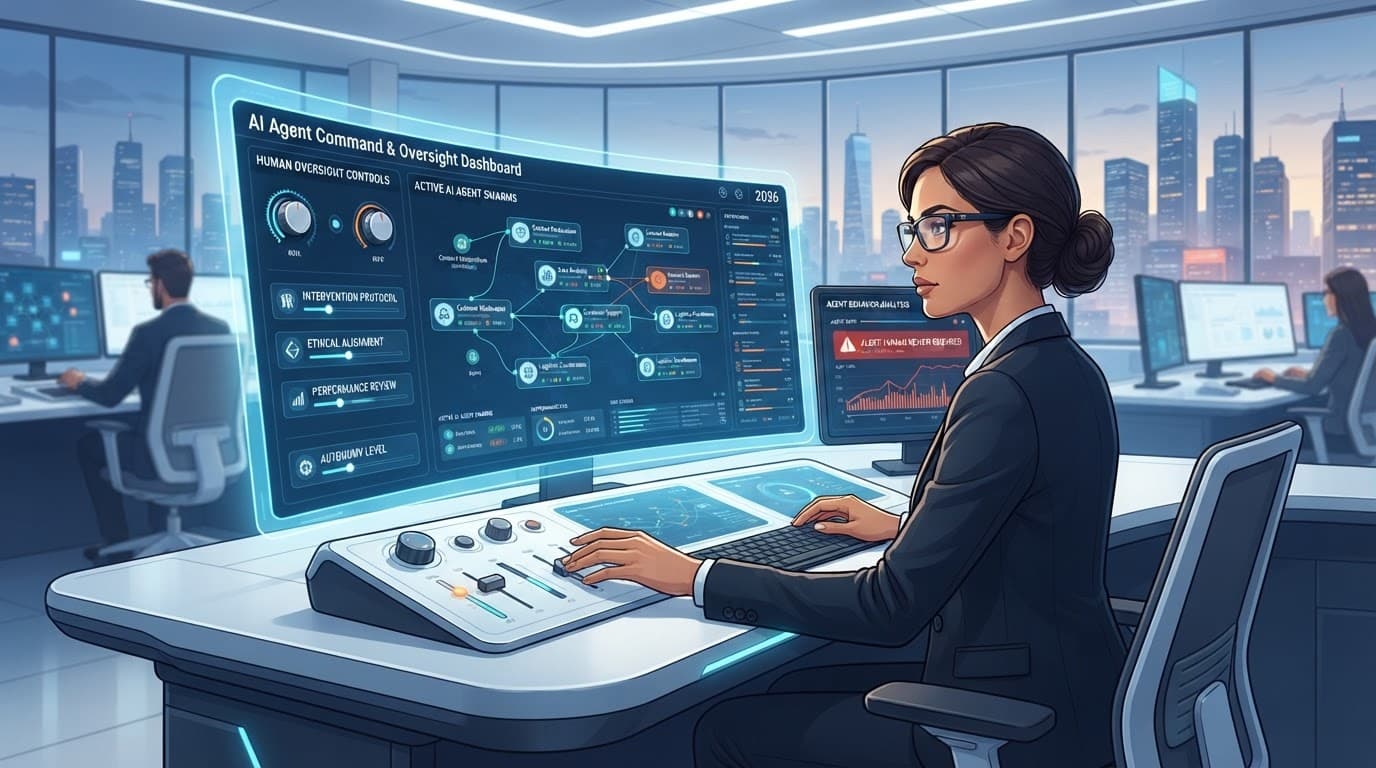
The workplace is undergoing a fundamental shift. AI agents are no longer simple chatbots—they are autonomous workers capable of handling multi-step tasks, making decisions, and executing actions with minimal human intervention. But with this power comes risk: privacy concerns, security vulnerabilities, bias, and accountability gaps that demand skilled human oversight.
This is where the AI Agent Handler emerges as one of the most critical roles of 2026. Whether you come from a technical background or have spent years as an operator, marketer, or domain specialist, your ability to manage, govern, and orchestrate AI agents is becoming indispensable.
The World Economic Forum ranks AI and big data as the fastest-growing skills through 2030, with 86% of surveyed employers expecting AI and information-processing technologies to transform their businesses by 2030. The professionals who develop agent management capability now will enter a progressively smaller pool of qualified candidates as demand accelerates.
An AI Agent Handler is a professional who directs, supervises, and governs autonomous AI systems within an organization. Unlike traditional AI engineers who focus primarily on building models, handlers operate at the intersection of technology, business operations, and risk management.
In an orchestrator role, a person establishes the objective, assigns work, defines constraints, and reviews the agents' results. This includes designing human-in-the-loop and human-on-the-loop controls that give organizations ways to supervise autonomous systems—approving sensitive actions before execution, reviewing completed analyses, or intervening when an agent's confidence falls below an established threshold.
The EU AI Act requires high-risk AI systems to be designed so people can oversee them while in use. Article 14 sets five capabilities for the assigned overseer, including the ability to understand system capacities and limits, interpret outputs, decide to disregard or reverse them, and stop the system through a stop button or similar procedure. Under Regulation (EU) 2026/1744, Annex III obligations apply from December 2, 2027.
Research from Anthropic reveals concerning patterns in how humans interact with AI agents: users approve 93% of Claude Code permission prompts, a phenomenon described as approval fatigue. Auto-approve use grows from about 20% of sessions for new users to over 40% at 750 sessions, meaning oversight shifts from per-action review to monitoring over time. OWASP names excessive autonomy—no independent approval of high-impact actions—as one of three root causes of Excessive Agency.
Organizations deploying agent-plus-human systems are scaling faster than those relying on full automation or manual processes alone. The Model Context Protocol specification explicitly states there should always be a human in the loop with the ability to deny tool invocations.
While not every handler needs deep engineering expertise, technical literacy is essential. You should understand how agents call tools, exchange data, maintain state, retrieve information, and recover from errors.
| Skill Category | Specific Capabilities | Why It Matters for Oversight |
|---|---|---|
| Programming | Python fundamentals | Read and trace agent logic, understand failure modes |
| AI/ML Concepts | LLM behavior, prompt engineering, RAG | Diagnose why agents produce incorrect or biased outputs |
| Agent Frameworks | LangGraph, CrewAI, LangChain, AutoGen, Semantic Kernel | Evaluate which frameworks suit specific governance needs |
| Data Systems | Vector databases, APIs, MCP | Understand data flows and potential exposure points |
| Infrastructure | Cloud deployment, MLOps | Monitor system performance and cost implications |
Autonomous systems introduce concerns involving privacy, security, bias, explainability, and accountability. Effective handlers must:
PwC's 2026 AI predictions describe a "rise of the generalist"—organizations increasingly need workers who can think across departments and disciplines rather than deep specialists in a single silo. When AI handles specialized execution, human value shifts to understanding how marketing connects to operations, how customer data informs product design, and how regulatory changes affect multiple business units simultaneously. Analytical thinking ranks as the number one skill employers want, with 7 in 10 companies calling it essential.
Handlers must translate agent outputs into actionable business intelligence, explaining limitations and confidence levels to stakeholders who may lack technical backgrounds.
Start with Python if your programming skills need strengthening. If you're already a developer, you can compress this phase significantly. The key is honest self-assessment: weak Python foundations make agentic AI journeys painful because under the hood, agent systems are just code.
Simultaneously, begin using AI agents in your current role. Platforms like Zapier, Make, and Microsoft Copilot Studio offer accessible entry points. Document everything: "Reduced report generation time by 40% using AI-assisted analysis" or "Managed AI-driven customer service workflow handling 500+ tickets per week." Quantified results showing human-AI collaboration are the strongest signals hiring managers look for in 2026.
Build hands-on experience with agent frameworks. You do not need to master every framework, but you should understand their relative strengths. LangGraph excels at complex state management, CrewAI emphasizes multi-agent collaboration, and Semantic Kernel integrates tightly with Microsoft ecosystems.
Develop three foundational projects:
For dedicated learners, consistent practice enables building solid agent-based projects within 3 to 6 months. Developers may achieve functional prototypes in 4 to 8 weeks.
Deepen your understanding of when agents should request human approval. Ask when an action is irreversible, moves money, touches regulated data, changes permissions, or crosses a trust boundary—such as issuing refunds, deleting records, or deploying to production. Read-only and reversible actions can run without prompts, keeping approval volume manageable for reviewers.
Study the EU AI Act's requirements for high-risk systems. Understand that Article 14 requires design for effective human oversight, including override and stop capabilities, even if it does not use the phrase "human in the loop."
Formal preparation remains the most reliable route to developing AI agent management capability with the depth and credibility that career advancement demands. For technology professionals seeking a top machine learning certification in this domain, the USAII Certified Artificial Intelligence Engineer (CAIE) offers a rigorous, self-paced program designed to equip professionals with the applied AI engineering skills that 2026 roles require.
Structured across 8 to 10 hours of weekly learning, the CAIE provides both the conceptual grounding and practical fluency that responsible agent management demands.
Update your resume and LinkedIn to highlight AI collaboration with quantified outcomes. The capacity to identify precisely where an agent breakdown occurred—whether in the instruction, context, model reasoning, or evaluation criteria—is a critical diagnostic capability that separates guesswork from professional refinement.
In the United States, AI engineer and agentic AI roles are commanding strong compensation. Most mid-level professionals earn between $130,000 to $200,000 per year. However, the majority of agentic AI-related job growth is in non-technical positions—oversight, governance, change management, and domain-specific application of AI tools.
The credential and experience gap between early movers and late adopters in this area will widen at pace with agent deployment rates. Organizations that formalize agent governance through structured competency frameworks will outperform those that address it reactively.
No. While technical roles in AI development require specialized degrees, the majority of agentic AI-related job growth is in non-technical positions. The most important skill is understanding how AI agents work within your specific industry and being able to demonstrate real-world results. Start by using AI tools in your current role and documenting the outcomes.
No. The capacity for diagnostic precision—identifying where agent breakdowns occur—is valuable at every career stage. What matters is demonstrated competence in orchestrating human-AI workflows, not years of traditional management experience.
Design tiered approval systems. Read-only and reversible actions can run automatically. Reserve human review for irreversible actions, financial transactions, regulated data access, and permission changes. This keeps approval volume low enough for reviewers to stay genuinely attentive.
The right choice depends on project complexity and organizational needs. LangGraph, CrewAI, LangChain, AutoGen, and Semantic Kernel are the most widely adopted in 2026. Start with the framework best supported by your organization's existing infrastructure.
The most in-demand AI role of 2026 does not require a traditional technical background—it requires the ability to manage autonomous systems responsibly. Companies are deploying AI agents to handle work that used to take entire teams, and someone must direct, govern, and oversee them.
That someone is increasingly coming from the people who have spent years understanding how work actually moves inside a company—the operators, the marketers, the fixers. If that sounds like you, you're closer than you think.
The professionals and organizations that act with deliberate intent in 2026 will not simply adapt to what follows. They will be positioned to lead it. Begin building your agent literacy today, document your human-AI collaboration outcomes, and pursue structured credentials that validate your governance capabilities. The demand for skilled AI Agent Handlers is surging—and the window for early advantage remains open.

Content Team
We are a team of AI enthusiasts and educators dedicated to helping you navigate the complex world of Artificial Intelligence. Our mission is to provide clear, actionable learning paths for every tech career.
Stop guessing what to learn next. Let our AI generate a personalized, step-by-step learning roadmap tailored exactly to your goals and current skill level.
Get Started for Free