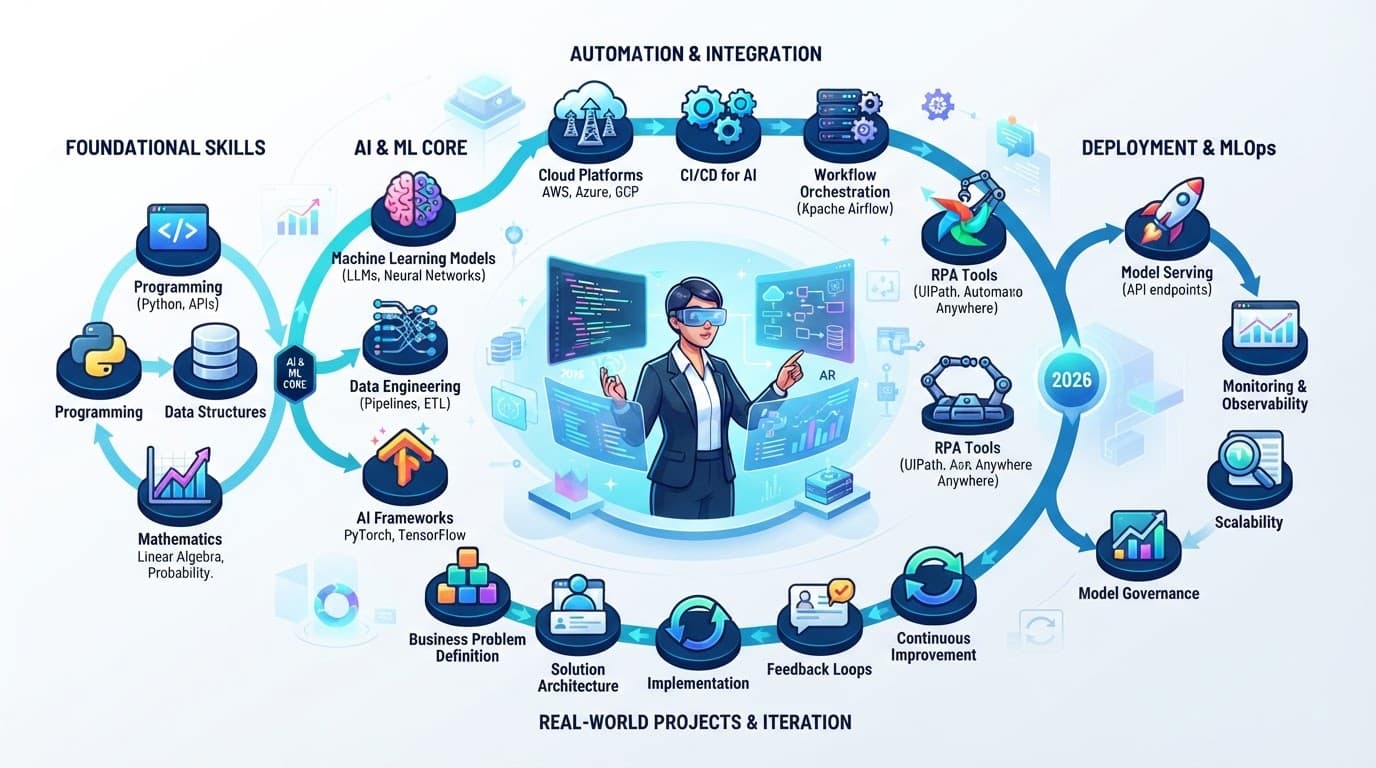
The AI Automation Engineer role has evolved significantly. In 2026, this isn't about building flashy demos or researching novel models. As industry practitioners note, an AI Automation Engineer is someone who can ship AI into real products, make it reliable, make it measurable, and make it cost-efficient.
This distinction matters. Companies aren't hiring model researchers—they're hiring engineers who can bridge the gap between AI capabilities and business outcomes. The focus is on predictable automation, not cool demos.
Whether you're starting from zero, transitioning from traditional RPA platforms like UiPath or Automation Anywhere, or pivoting from data science, there's a defined path forward. The timeline ranges from 8 to 12 months for complete beginners to 6 to 9 months for those with relevant technical backgrounds.
Your starting point determines your optimal roadmap. Here are the three most common paths:
This is the longest but most accessible route. You'll need to build foundational skills before specializing:
The first few months focus on programming fundamentals and basic mathematics. Once comfortable, learners gradually move into machine learning, deep learning, and practical AI projects.
Engineers with existing UiPath or Automation Anywhere expertise have domain knowledge and platform skills but need to add the AI layer. This requires:
This path demands more technical depth but offers the advantage of existing industry relationships and domain knowledge. Timeline: 6-9 months.
Data scientists bring strong ML fundamentals but often lack the engineering discipline for production automation systems. Typical gaps include:
Timeline: 6-12 months.
Regardless of entry path, certain skills are non-negotiable for AI Automation Engineers in 2026:
| Skill Category | Specific Competencies | Why It Matters |
|---|---|---|
| Programming Foundations | Python, Git, SQL, APIs, backend development | AI Engineers are software engineers first; weak fundamentals make every project confusing |
| AI/ML Core | Machine learning, deep learning, embeddings, RAG | Essential for building intelligent automation systems |
| LLM & Agent Technologies | LLM APIs, prompt engineering, agent-based systems, multi-agent orchestration | The fastest-growing area of AI automation demand |
| Engineering Practices | Docker, deployment, CI/CD, testing, code quality | Distinguishes prototypes from production systems |
| Business Acumen | Process analysis, cost optimization, reliability engineering | Employers need measurable business impact, not technical novelty |
| Cognitive Skills | Problem framing, experimentation, analytical thinking | Defines the right problems and diagnoses failures effectively |
The most effective strategy for breaking into AI automation engineering is building demonstrable skills through three increasingly complex projects. Forget 20 tiny projects—build serious systems that prove you can ship production-grade AI.
Build an end-to-end automation using UiPath or n8n that solves a real problem. Examples include:
This project demonstrates core AI engineering competencies:
The capstone project showing advanced capabilities:
Alternative project combinations that cover essential skills include an AI resume reviewer, a PDF chatbot with citations, and a research agent—each demonstrating structured outputs, RAG, embeddings, tool use, agents, deployment, and product thinking.
A structured plan for those starting early in 2026 encompasses seven phases:
This roadmap emphasizes hands-on projects, consistent learning, and adapting to market demands to achieve freelance income and secure a remote position by year-end.
Several principles separate successful AI Automation Engineers from those who struggle:
Agents without fundamentals are just demos. Learn planning versus execution, memory patterns, multi-agent orchestration, human-in-the-loop workflows, and tool reliability. The goal is predictable automation, not flashy agents.
Portfolio beats certificates every time. Hiring managers want to see that you can build real software. A polished project with clear documentation stands out more than ten unfinished experiments.
Theory alone is insufficient. Projects force you to deal with messy data, experiment with different models, and troubleshoot problems that don't appear in tutorials. Consistently building projects and applying concepts is the most effective way to progress.
No. While mathematical intuition helps, the emphasis in 2026 is on engineering execution rather than research innovation. Software engineering fundamentals are more critical than theoretical depth.
Realistically, 8 to 12 months for dedicated learners starting from scratch. Those with software or data backgrounds may progress faster. The key variable is consistent project building, not just tutorial completion.
There's a significant jump in demand for generative AI, LLMs, RAG, AI agents, and MLOps skills. Companies particularly need engineers who can make AI systems reliable, measurable, and cost-efficient.
Projects overwhelmingly. Build at least 2-3 serious systems that demonstrate end-to-end capabilities. Certificates may help with initial screening, but hiring decisions hinge on demonstrated ability to ship working AI systems.
Yes, but with an important caveat. Traditional RPA skills provide domain knowledge and platform familiarity, but you must add the AI layer—Python at production level, LLM integration, and agent-based architectures—to remain competitive.
The AI Automation Engineer role in 2026 represents a convergence of software engineering discipline, AI capabilities, and business process understanding. The opportunity is substantial—demand for these skills continues growing across industries globally.
The path is clear: establish your software engineering foundation, master the AI/ML core, build three serious portfolio projects, and demonstrate that you can ship reliable, measurable, cost-efficient automation systems.
The timeline is realistic but requires commitment. Whether you need 6 months or 12, the next phase of your career starts with today's first project. Begin with Python fundamentals, progress through structured learning, and never skip the hands-on application that transforms knowledge into employable skill.
Ready to accelerate your AI automation journey? Explore personalized learning roadmaps and project-based curricula at LearnAIRoadmap.com.

Content Team
We are a team of AI enthusiasts and educators dedicated to helping you navigate the complex world of Artificial Intelligence. Our mission is to provide clear, actionable learning paths for every tech career.
Stop guessing what to learn next. Let our AI generate a personalized, step-by-step learning roadmap tailored exactly to your goals and current skill level.
Get Started for Free