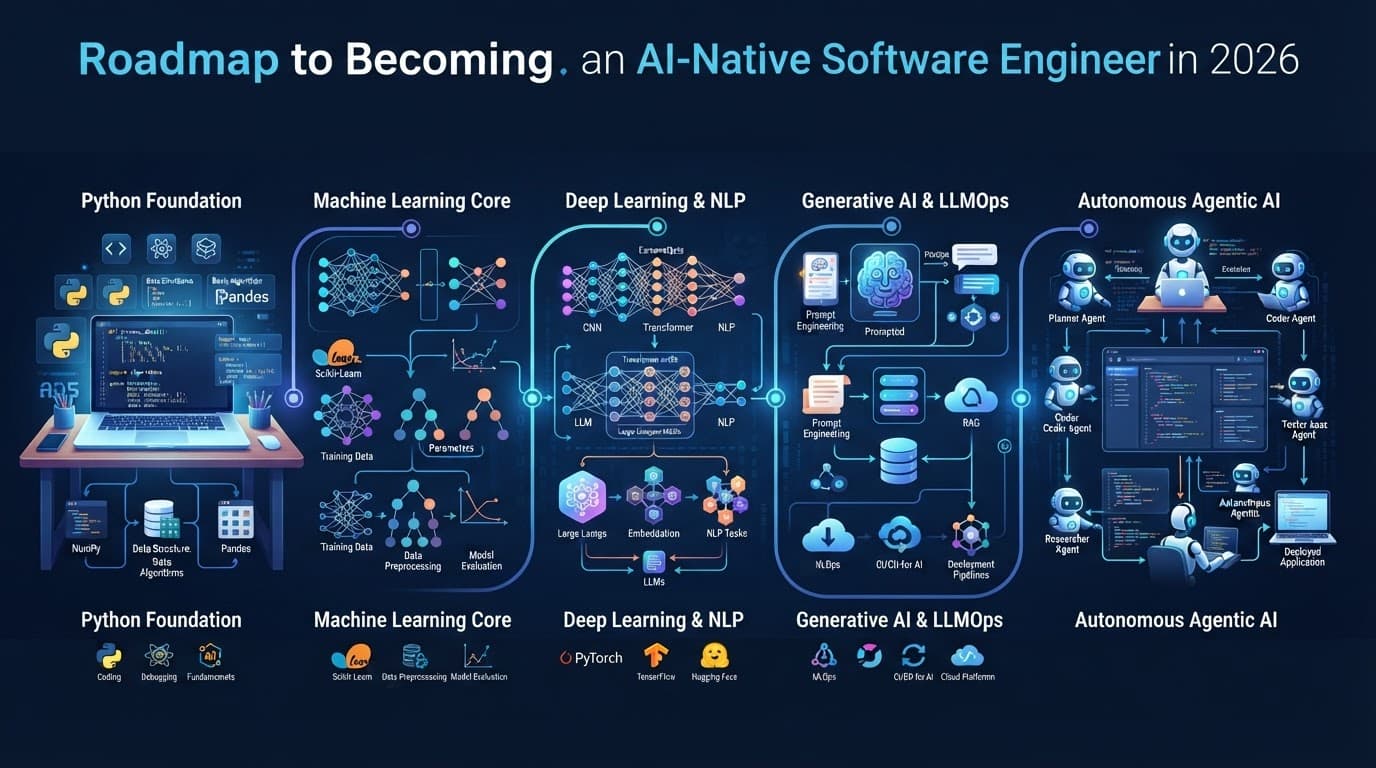
Everyone wants to become an AI engineer in 2026. But most people are learning the wrong way—spending months watching tutorials, collecting certificates, and trying dozens of tools, yet still unable to build a single production-ready AI system.
The reality? AI engineering in 2026 is not about "knowing AI tools." It's about building AI systems like an engineer.
At LearnAIRoadmap.com, we've studied the actual skill requirements from job postings, bootcamp curricula, and working engineers to build this practical roadmap. Whether you're a college student, fresh graduate, working developer, or career switcher, this guide gives you the structured path to become an AI-native software engineer—the kind that companies actually hire.
This learning path is designed for:
If you're completely new to programming, start with Python and software engineering fundamentals. If you already have development experience, you can move more quickly into LLM integration and agent development.
Before diving into the roadmap, understand this critical distinction. Most AI failures are not model issues—they're evaluation failures. Most learners focus only on tools like machine learning libraries or AI frameworks. But companies are hiring problem solvers, not tool users.
An AI-native software engineer builds systems where a language model decides what to do next, calls tools, holds state, and recovers from failure. This is fundamentally different from training or fine-tuning models—it's about system design.
Be transparent about what you built yourself, what you adapted from documentation, and where you used AI coding assistance. You should be able to explain the important parts of your code during an interview.
The following plan works for someone who can dedicate around two to three hours daily. Beginners may need more time, particularly for programming and software engineering fundamentals.
Month one is about traditional software engineering skills—because you cannot ship AI if you cannot ship software.
Core skills to master:
Build these projects:
Key principle: If you can't ship an API with tests, you're not ready for production AI.
Month two introduces machine learning concepts and data thinking—not as a subject to memorize, but as a system to understand.
ML fundamentals:
Data structures & algorithms focus:
Structured thinking and optimization skills separate tool users from problem solvers. Key applications include:
Think of it this way: if AI is the engine, DSA is the fuel that makes it powerful.
Month three addresses where most AI engineering work actually happens in 2026: data and retrieval. This is where the jobs are.
Focus on:
Build projects that solve real retrieval problems, not toy examples.
Beyond the 90-day foundation, think about your development in four levels:
| Level | Focus | Key Outcome |
|---|---|---|
| Level 1 | Python, SQL & API Foundations | Ship basic applications with confidence |
| Level 2 | Harnessing AI Models | Integrate LLMs, understand prompting, context engineering |
| Level 3 | Shipping Real AI Systems | End-to-end RAG, agents, deployment-ready projects |
| Level 4 | Landing the AI Engineer Job | Portfolio, interviews, system design at scale |
Real agentic AI engineer job postings from 2026 reveal the actual skills in demand. Here's what matters, organized by category:
To truly stand out, build production-ready enterprise AI systems using:
The goal is completing end-to-end enterprise capstone projects that demonstrate security, observability, and scalability—not just functionality.
Not everything trending is necessary. Consider skipping or delaying:
The 90-day foundation is a practical starting point for dedicated learners (2-3 hours daily). However, reaching enterprise-ready proficiency typically requires 6-12 months of consistent project building.
No. While helpful, the field prioritizes demonstrated ability to build and ship systems. A strong portfolio of production-quality projects often outweighs formal credentials.
AI engineers build systems around existing models—integrating LLMs, designing retrieval, orchestrating agents. ML engineers focus more on training, fine-tuning, and optimizing models themselves. The roles increasingly overlap, but AI engineering emphasizes system design over model development.
Python is the primary language for AI engineering. Java can be valuable for performance-heavy applications, but start with Python and expand only when specific roles require it.
Increasingly critical. AWS deployment skills appear in most senior AI engineering roles. Docker and containerization are now baseline expectations.
The path to becoming an AI-native software engineer in 2026 is clear: engineer first, AI second. Master Python, Git, SQL, and APIs. Understand machine learning as systems thinking, not just theory. Dive deep into data retrieval where the jobs actually are. Then layer on agentic AI tools—LangGraph, MCP, vector databases, and enterprise deployment patterns.
Most importantly, build in public. Create projects you can explain line-by-line. Be honest about what you built, what you adapted, and where AI assisted you. The engineers who thrive in 2026 won't be the ones who watched the most tutorials—they'll be the ones who shipped the most systems.
Ready to start your journey? Explore structured learning paths and hands-on projects at LearnAIRoadmap.com.

Content Team
We are a team of AI enthusiasts and educators dedicated to helping you navigate the complex world of Artificial Intelligence. Our mission is to provide clear, actionable learning paths for every tech career.
Stop guessing what to learn next. Let our AI generate a personalized, step-by-step learning roadmap tailored exactly to your goals and current skill level.
Get Started for Free