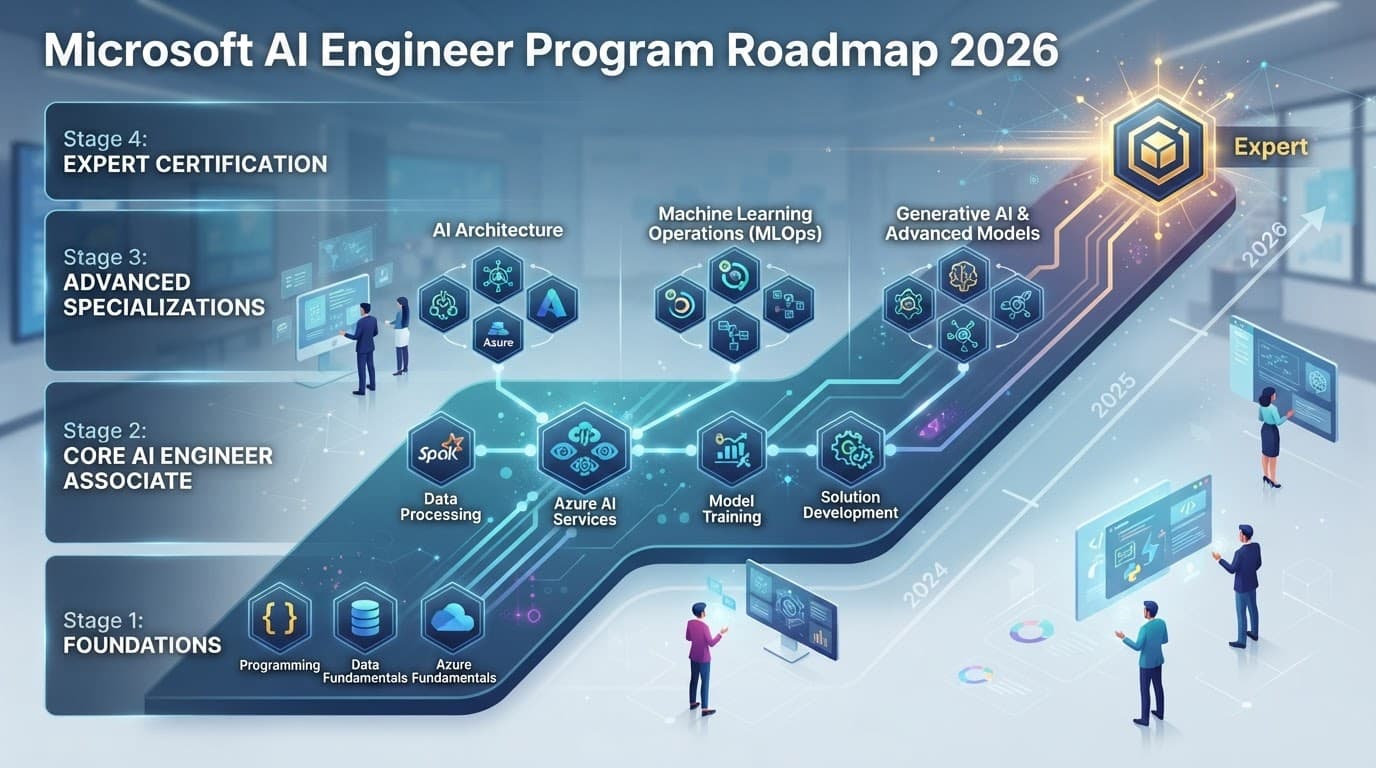
AI engineering has emerged as one of the most sought-after career paths in technology. With companies competing aggressively for talent who can build real AI solutions—not just discuss them—earning a recognized credential has become essential for standing out. The Microsoft AI Engineer Program, developed jointly by Simplilearn and Microsoft, offers a structured pathway to develop practical skills in Python, machine learning, deep learning, and generative AI while preparing for industry-recognized Azure certifications.
This guide provides a comprehensive 2026 roadmap for aspiring AI engineers, covering the skills you'll build, the certifications that validate your expertise, and how to position yourself for roles in this rapidly expanding field.
The Microsoft AI Engineer Program is a joint offering by Simplilearn and Microsoft designed to help professionals build end-to-end AI solutions using Microsoft Azure. The program emphasizes practical, hands-on learning over theoretical knowledge alone.
According to the program overview, learners develop skills across multiple domains:
The curriculum incorporates leading tools and frameworks including PyTorch, TensorFlow, LangChain, Hugging Face, OpenAI, ChatGPT, AutoGen, Microsoft Copilot Studio, GitHub Copilot, and Azure AI. Through labs, industry projects, and a capstone project, participants apply these technologies to solve real-world challenges.
Microsoft's certification landscape evolved significantly in 2026. Understanding the current structure—and recent changes—helps you choose the optimal path for your career goals.
Azure AI Fundamentals (AI-900 / AI-901)
The AI-900 exam provides conceptual understanding of AI and machine learning capabilities within Azure, covering computer vision, natural language processing, and generative AI services. No coding experience is required, making it ideal for beginners and business professionals.
Important update: AI-900 retires on June 30, 2026, replaced by AI-901. If you're starting your journey mid-2026, target AI-901 directly.
Azure AI Engineer Associate (AI-102)
The AI-102 certification validates your ability to design and implement production AI solutions using Azure Cognitive Services, Azure OpenAI, and Azure Machine Learning. This credential requires Python or C# programming experience and focuses on practical integration of AI models into existing applications.
| Certification Detail | Information |
|---|---|
| Target audience | Software developers, engineers adding AI capabilities |
| Coding required | Yes (Python or C#) |
| Preparation time | 2-4 months |
| Exam cost | $165 |
| Typical salary range | $120,000-$165,000 |
Critical 2026 Update: AI-102 retires on June 30, 2026. Its successor, AI-103 Azure AI App and Agent Developer Associate, becomes the primary credential for developers building, deploying, and optimizing AI solutions on Azure—including generative AI, computer vision, and intelligent agents.
Microsoft introduced several new credentials reflecting evolving industry needs:
For professionals driving AI strategy without hands-on coding:
The 2026 job market demands engineers who can build complete solutions, not just train models in isolation. Based on current certification requirements and industry trends, prioritize these skill areas:
Microsoft emphasizes six principles that 2026 certifications test thoroughly:
Practical application includes Azure AI Content Safety implementation, compliance awareness (GDPR, HIPAA), and evaluation methodologies—not just theoretical knowledge.
For candidates targeting associate-level certification, this structured approach aligns with current exam priorities:
| Weeks | Focus Area | Key Activities |
|---|---|---|
| 1-2 | Azure AI fundamentals | Complete AI-900/AI-901; understand Azure service categories |
| 3-4 | Computer vision | Build projects with Azure AI Vision, custom vision models |
| 5-6 | Natural language processing | Implement language understanding, translation, and speech services |
| 7 | Azure OpenAI integration | Develop with GPT models, understand API patterns |
| 8 | Azure AI Foundry | Model catalog workflows, prompt flow orchestration, multi-agent patterns |
| 9 | Responsible AI | Apply Microsoft principles, implement content safety, compliance review |
| 10-11 | Advanced scenarios | RAG implementation, knowledge mining, document intelligence |
| 12 | Exam preparation | Practice tests, documentation review, weak area reinforcement |
Certifications validate knowledge; portfolios demonstrate capability. The Microsoft AI Engineer Program emphasizes real-world projects, and you should extend this approach independently.
Effective portfolio projects for 2026 include:
Document your work thoroughly. Maintain detailed notes on configuration steps, API integrations, troubleshooting processes, and performance observations. These references prove invaluable during interviews and when implementing similar solutions professionally.
Select credentials based on your background and career direction:
| Your Profile | Recommended Path |
|---|---|
| Zero AI experience | AI-901 → AB-730 (business) or AI-103 (technical) |
| Software developer | AI-901 → AI-102 (before June 2026) or AI-103 → AI-300 |
| Data scientist / ML engineer | AI-901 → AI-103 → AI-300 (MLOps) → AI-500 (expert) |
| Senior business leader | AI-901 → AB-731 |
| IT admin / Microsoft 365 specialist | AI-901 → MS-012 (Copilot administration) |
The program provides structured learning with hands-on labs, industry projects, and preparation for recognized Microsoft certifications. For professionals seeking organized skill development with clear credentialing outcomes, it offers efficient progression compared to self-directed learning alone.
If you can schedule and pass AI-102 before its June 30, 2026 retirement, it remains a recognized credential. However, AI-103 covers emerging technologies including intelligent agents and updated Azure services. Starting mid-2026, AI-103 is the logical choice.
Python or C# experience is required. You should be comfortable with API integration, SDK usage, and basic software development lifecycle principles before attempting AI-102 or AI-103.
The AI-102 certification correlates with salary ranges of $120,000-$165,000, though actual compensation varies by location, experience, and specific role. The broader AI engineer market has seen substantial growth, with strong demand for professionals who can implement production solutions.
Microsoft certifications typically require annual renewal through free online assessments. Stay current with Azure service updates, as the platform evolves continuously.
The Microsoft AI Engineer Program and associated certifications provide a credible pathway into one of technology's fastest-growing fields. Success in 2026 requires more than passing exams—you need demonstrable skills building production AI solutions on Azure.
Start with fundamentals through AI-901, progress to technical implementation with AI-103, and specialize based on your interests in MLOps, multi-agent systems, or business transformation. Combine structured learning with independent portfolio projects that showcase your ability to solve real problems.
The engineers who thrive are those who can bridge theory and practice: understanding both how algorithms work and how to deploy them reliably, responsibly, and at scale. Begin your roadmap today, and position yourself for the opportunities this expanding field continues to create.
Content Team
We are a team of AI enthusiasts and educators dedicated to helping you navigate the complex world of Artificial Intelligence. Our mission is to provide clear, actionable learning paths for every tech career.
Stop guessing what to learn next. Let our AI generate a personalized, step-by-step learning roadmap tailored exactly to your goals and current skill level.
Get Started for Free