Machine learning models that never leave a Jupyter notebook create zero business value. The engineers who bridge that gap—who turn experiments into reliable, scalable production systems—are MLOps engineers. In 2026, as organizations race to operationalize AI and increasingly deploy large language models, this role has moved from niche to essential.
Whether you're switching from software engineering, leveling up from data science, or entering tech fresh, this roadmap provides a structured, time-bound path to your first MLOps role. No guesswork. No endless tutorial loops. Just the skills, tools, and projects that actually get you hired.
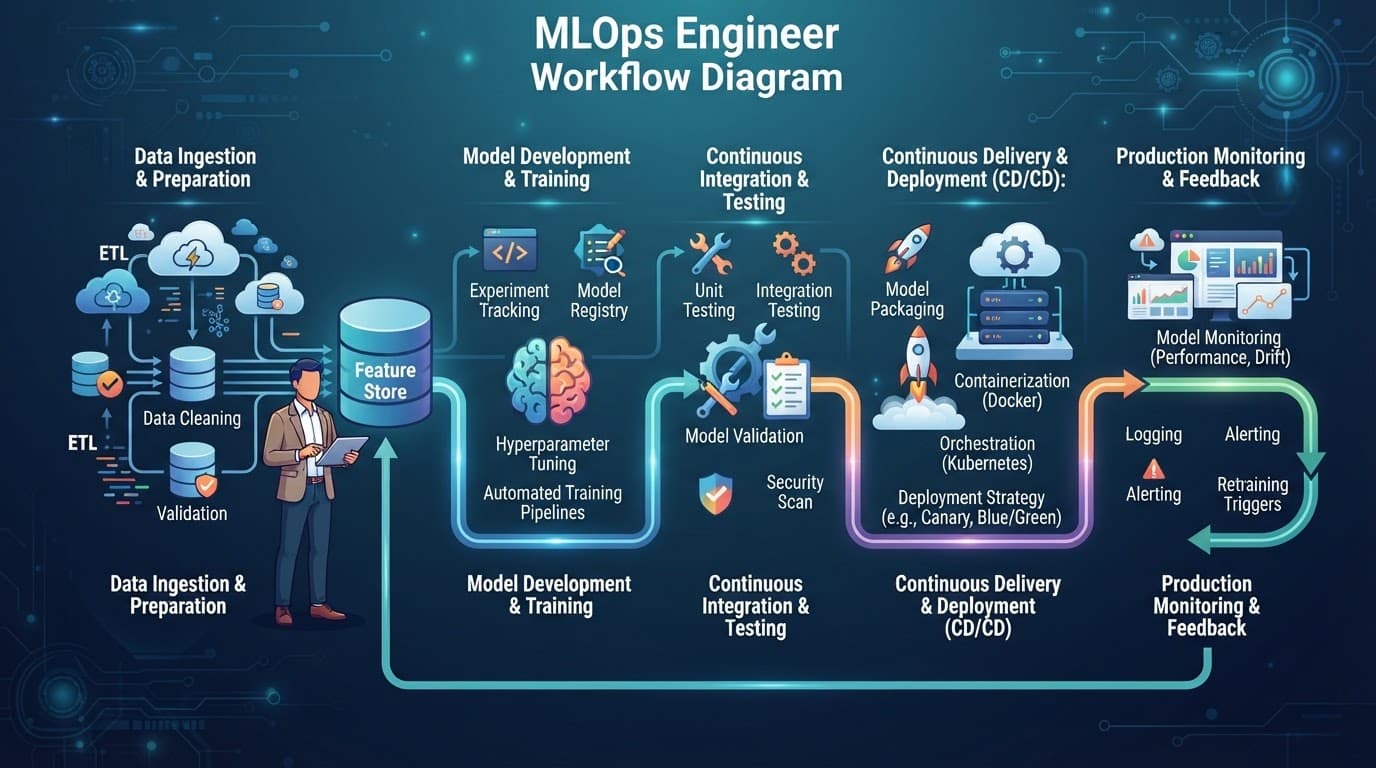
MLOps engineers build and maintain the pipelines that transport ML models from notebooks to production. Their daily work spans automating training and retraining, versioning data and models, deploying with CI/CD, setting up monitoring for drift and performance degradation, and collaborating across data science, engineering, and operations teams.
In 2026, the role increasingly includes LLMOps—operationalizing large language models with specialized serving infrastructure, prompt versioning, and evaluation frameworks that go beyond traditional ML monitoring.
This roadmap treats learning as a sequence, not a checklist to rush. Each stage builds on the previous one, with a concrete milestone that proves your skills.
Resist the temptation to skip ahead to shiny tools. A shaky foundation slows everything that follows.
Milestone: Push a Python data pipeline to GitHub with proper documentation and a working README.
Now layer in the technologies that define modern MLOps practice.
| Tool Category | Primary Tools to Learn | What It Solves |
|---|---|---|
| Containerization | Docker | Reproducible environments across dev/staging/production |
| Orchestration | Kubernetes | Scaling and managing containerized ML workloads |
| Experiment Tracking | MLflow | Versioning models, parameters, and artifacts |
| CI/CD Automation | GitHub Actions | Automated testing, building, and deployment pipelines |
| Workflow Orchestration | Apache Airflow | Scheduling and monitoring complex data pipelines |
Milestone: Containerize a trained model with Docker, track its training run in MLflow, and deploy it via a GitHub Actions pipeline.
Projects beat passive courses. This is where you transform knowledge into proof.
Consider adding LLMOps exposure here: build a RAG application with vector database integration, prompt versioning, and evaluation metrics that separate demos from dependable products.
Milestone: A public GitHub portfolio with 2–3 production-grade projects, each with architecture diagrams and performance benchmarks.
Translate your technical preparation into career momentum.
Milestone: Active LinkedIn presence with project showcases, applied to 10+ targeted roles with customized materials.
Most committed learners reach employability in 6–9 months with consistent study and hands-on projects. The full structured path typically spans 6–12 months, with variation based on your starting point:
| Background | Estimated Timeline | Key Accelerators |
|---|---|---|
| Software engineer pivoting | 4–6 months | Strong coding foundation; focus on ML concepts and MLOps tooling |
| Data scientist transitioning | 5–7 months | ML knowledge exists; prioritize DevOps, infrastructure, and engineering practices |
| Career changer / self-taught | 8–12 months | Build fundamentals first; portfolio quality matters more than speed |
Consistency matters more than intensity. A sustainable weekly rhythm of focused study and building beats occasional cramming sessions.
The typical progression offers both technical and management tracks:
At senior levels, the path splits: continue as an individual contributor focused on architecture and technical strategy, or transition to management as an Engineering Manager → Director of ML Platform.
A degree helps but is not mandatory. What matters more is demonstrating capability through:
Many successful MLOps engineers are career-switchers who built demonstrable portfolios rather than relying on credentials alone.
A growing share of MLOps work in 2026 involves systems around existing models rather than training from scratch. The AI engineering layer—working with LLM APIs, embeddings, vector databases, retrieval-augmented generation, and rigorous evaluation—has become integral to the MLOps scope.
Your roadmap should include:
Technical preparation alone doesn't guarantee employment. Execute deliberately on these fronts:
LinkedIn as your primary platform — keep your profile current, share what you're building, engage with MLOps discussions, and turn on job alerts for: MLOps Engineer, ML Platform Engineer, AIOps Engineer, ML Infrastructure Engineer.
Internal transitions — if currently employed in a technical role, advocate for MLOps investment in existing AI initiatives. Real-world experience with deployment and governance problems builds credibility while reducing career risk.
Targeted applications — smaller companies and startups often provide broader hands-on experience than large, process-heavy organizations. Don't discount them for your first role.
Yes. MLOps remains in strong demand, particularly in tech hubs like Hyderabad and across India globally. Organizations scaling AI need engineers who can ship reliable, maintainable systems—not just build models.
MLOps covers traditional machine learning lifecycle management. LLMOps extends this to large language models with specialized concerns: prompt versioning, retrieval-augmented generation infrastructure, token-cost optimization, and LLM-specific evaluation metrics.
You need basic ML literacy—understanding training, evaluation, features, and overfitting. You don't need to be a research scientist. Many MLOps engineers come from software engineering backgrounds and learn ML fundamentals alongside operational tools.
Cloud provider certifications (AWS ML Specialty, GCP Professional ML Engineer) and tool-specific credentials validate skills. However, your portfolio carries more weight in hiring decisions than any certificate.
Quality over quantity. Two to three end-to-end projects that demonstrate different challenges—batch prediction, real-time serving, and LLM operationalization—outperform ten tutorial replications.
The MLOps field rewards practitioners who ship. Every week you spend passively consuming content without applying it delays your job readiness. Start with Python and Git this week. Containerize a simple model next week. Track an experiment the week after.
The 2026 MLOps landscape offers clear opportunity for those who combine foundational rigor with hands-on demonstration. Follow this roadmap sequentially, build publicly, and engage with the community. Your first MLOps role is closer than you think—typically 6–9 months of consistent, directed effort away.
Ready to structure your learning with personalized milestones? Explore how Learn AI Roadmap adapts your study plan to your background, available time, and career goals.

Content Team
We are a team of AI enthusiasts and educators dedicated to helping you navigate the complex world of Artificial Intelligence. Our mission is to provide clear, actionable learning paths for every tech career.
Stop guessing what to learn next. Let our AI generate a personalized, step-by-step learning roadmap tailored exactly to your goals and current skill level.
Get Started for Free