Artificial Intelligence (AI) has rapidly transitioned from science fiction into the core driver of modern technology. From generative language models like ChatGPT to autonomous vehicles and intelligent medical diagnostics, AI is reshaping how we live and work. As we navigate through 2026, understanding AI is no longer a niche skill reserved for researchers; it is a foundational literacy required for the future of work.
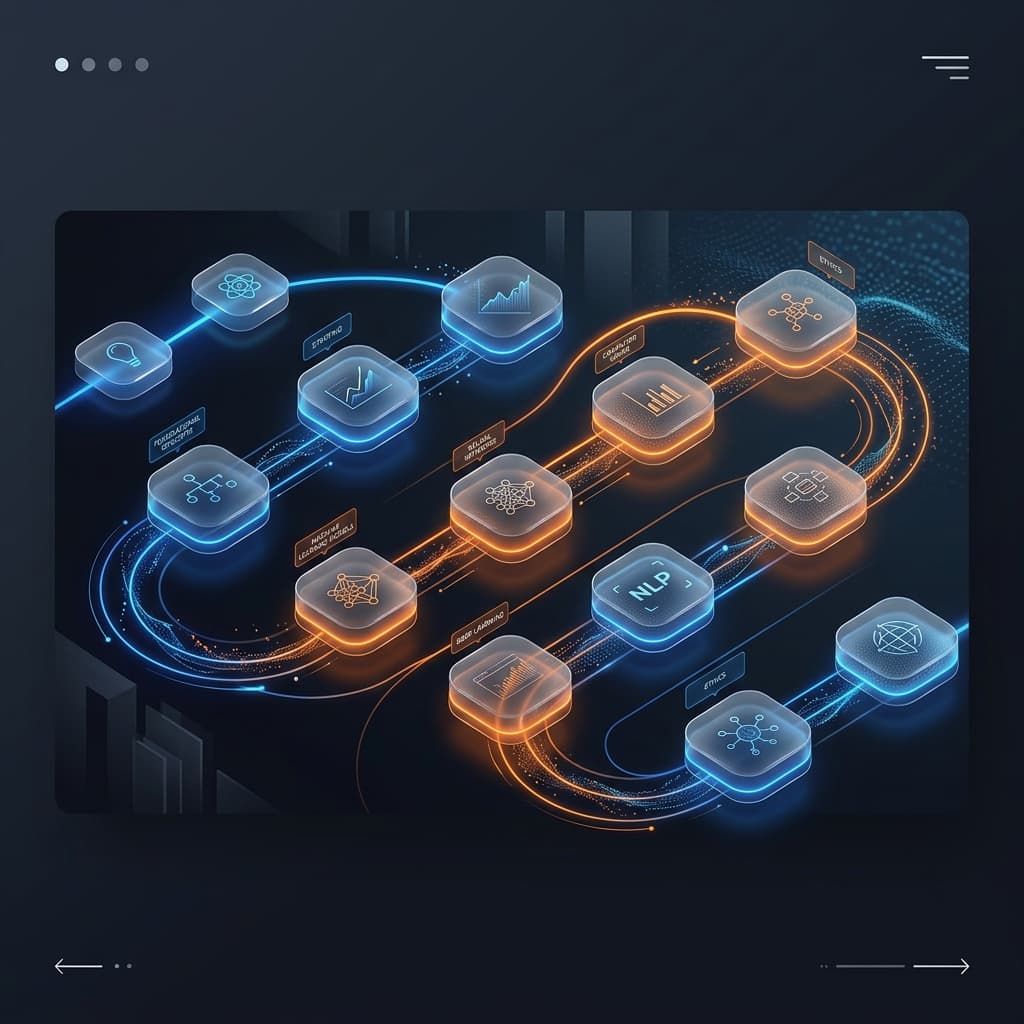
If you are reading this, you have likely realized the immense potential of AI and are wondering, "How do I even start?" The field can seem overwhelmingly vast, filled with complex mathematics, new programming paradigms, and an alphabet soup of frameworks (TensorFlow, PyTorch, LLMs, RAG). This comprehensive guide is designed to cut through the noise. We will provide you with a structured, step-by-step roadmap to go from an absolute beginner to a capable AI practitioner in 2026.
Before you can build complex neural networks, you must lay a strong foundation. Trying to learn Deep Learning without understanding basic programming or math is like trying to build a skyscraper on a swamp.
Python remains the undisputed language of Artificial Intelligence. Its simple syntax, readability, and massive ecosystem of data science libraries make it the perfect starting point.
NumPy for numerical computations and Pandas for data manipulation and analysis.You don't need a PhD in mathematics, but you do need an intuitive understanding of the math that powers AI algorithms.
Machine Learning (ML) is a subset of AI where computers learn from data without being explicitly programmed. In this phase, you will learn classical ML algorithms using the Scikit-Learn library.
This involves training a model on labeled data (where the "answer" is known).
This involves finding hidden patterns in unlabeled data.
Building a model isn't enough; you must know how well it performs.
Deep Learning uses Artificial Neural Networks inspired by the human brain. This is the technology behind today's most advanced AI applications.
Understand the architecture of a basic feedforward neural network: input layers, hidden layers, output layers, weights, biases, and activation functions (ReLU, Sigmoid, Softmax).
While TensorFlow is still widely used, PyTorch has become the industry standard for research and is increasingly dominating production environments due to its intuitive, Pythonic design. Focus deeply on PyTorch.
If you are interested in teaching computers to "see", study Convolutional Neural Networks (CNNs). Learn how filters, pooling layers, and strides work. Build projects like image classifiers or object detection models.
For processing sequential data like time-series or text, learn about Recurrent Neural Networks (RNNs) and Long Short-Term Memory (LSTM) networks.
The AI landscape changed forever with the invention of the Transformer architecture. This is the foundation of Generative AI.
Understand the "Attention is All You Need" paper. Learn how self-attention mechanisms allow models to understand the context of words in a sentence better than ever before.
Understand how models like GPT-4, Llama 3, and Claude work under the hood. Learn how to interact with their APIs.
This is where the industry is currently focused:
💡 Career Tip: To see which of these engineering skills are currently the most lucrative, check out our guide on the Top 5 AI Skills Employers Are Seeking.
A model on your laptop is a science project; a model deployed to the cloud is a product. Machine Learning Operations (MLOps) is the practice of deploying, monitoring, and maintaining AI models in production.
The roadmap outlined above is challenging, but it is also one of the most rewarding educational journeys you can embark upon in 2026. Remember that consistency is more important than intensity. Dedicate an hour or two every day, build real projects to solidify your knowledge, and don't be afraid to read documentation and research papers.
Artificial Intelligence is an active, rapidly evolving field. The tools will change, but the foundational concepts you learn here will remain relevant for decades. Welcome to the future—it's time to start building it.

Content Team
We are a team of AI enthusiasts and educators dedicated to helping you navigate the complex world of Artificial Intelligence. Our mission is to provide clear, actionable learning paths for every tech career.
Stop guessing what to learn next. Let our AI generate a personalized, step-by-step learning roadmap tailored exactly to your goals and current skill level.
Get Started for Free