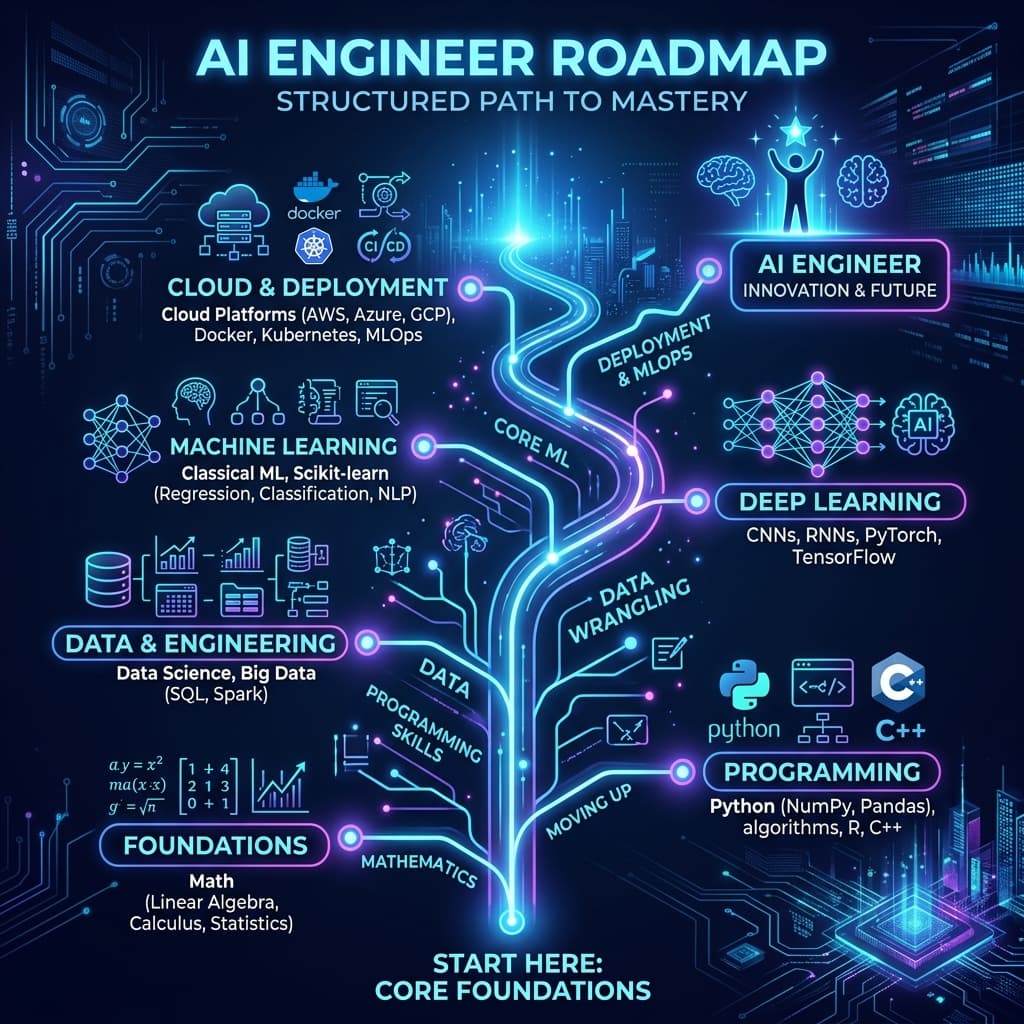
The tech industry is witnessing an unprecedented boom in Artificial Intelligence. However, there is a massive difference between knowing how to call an OpenAI API and being a true AI engineer who can build, optimize, and scale complex AI architectures. If you want to stand out, you need a structured learning roadmap. This guide serves as your comprehensive roadmap AI journey, designed to elevate you into the top 1% of AI professionals.
Building a successful career in AI requires more than just reading tutorials. You need a systematic approach. By utilizing an ai roadmap generator, you can tailor your learning path. But here, we provide the definitive top 1% AI engineer roadmap that covers everything from foundational mathematics to advanced Large Language Model (LLM) orchestration.
Every elite engineer starts with an unshakable foundation. You cannot optimize an architecture if you don't understand the underlying principles.
While libraries like PyTorch abstract away the math, top engineers understand what happens under the hood. Focus heavily on:
An AI engineer is, first and foremost, a software engineer. Writing clean, scalable, and modular code is essential. Master Python, but also consider learning high-performance languages like Rust or C++ for optimizing bottlenecks.
Once your foundation is solid, you must dive deep into neural networks.
PyTorch is the industry standard, but Google's JAX is rapidly gaining traction for high-performance machine learning research. A top 1% engineer is comfortable with both.
Understand the evolution of architectures: from CNNs and RNNs to Transformers and state-space models like Mamba. You must know when to use which architecture based on computational constraints and data types.
This is the frontier of current AI development. You must move beyond simple prompts.
Learn how to pre-train models and fine-tune them using techniques like LoRA (Low-Rank Adaptation) and QLoRA. Understand the intricacies of reinforcement learning from human feedback (RLHF) and Direct Preference Optimization (DPO).
Basic RAG is commoditized. Elite engineers build advanced RAG pipelines involving semantic chunking, hybrid search (keyword + vector), query rewriting, and re-ranking algorithms to ensure maximum accuracy and zero hallucinations.
Building a model is only 20% of the work. Deploying it reliably at scale is the remaining 80%.
Learn how to train massive models across multiple GPUs using libraries like DeepSpeed or FSDP (Fully Sharded Data Parallel).
Optimize models for production using quantization (making models smaller and faster) and serving frameworks like vLLM or TensorRT-LLM. You must know how to maximize GPU utilization and minimize latency.
Becoming a top 1% AI engineer is a marathon, not a sprint. This learning roadmap is your guide, but execution is up to you. For a more personalized plan, consider using our interactive ai roadmap generator to track your progress and customize your journey. Also, check out our guide on The Ultimate AI Learning Roadmap for Beginners in 2026 if you need to solidify your basics.

Content Team
We are a team of AI enthusiasts and educators dedicated to helping you navigate the complex world of Artificial Intelligence. Our mission is to provide clear, actionable learning paths for every tech career.
Stop guessing what to learn next. Let our AI generate a personalized, step-by-step learning roadmap tailored exactly to your goals and current skill level.
Get Started for Free